Best AI Story Generators 2026: Free AI Story Tools - BSTB

Psst! 13 story tools inside

13 Best AI Story Generators in 2026 for Plots, Characters, Chapters and Dialogue

AI story generators help with the parts of fiction that stall people: turning an idea into a plot, building characters who stay consistent, drafting the scene you cannot start, writing dialogue and carrying an unfinished manuscript forward. This page ranks the 13 best AI story generators on BSTB by their 9-criterion score, each with its pricing model, what it actually writes and a plain-English summary.

Top 13 of 19 tools 8 of 13 free to start
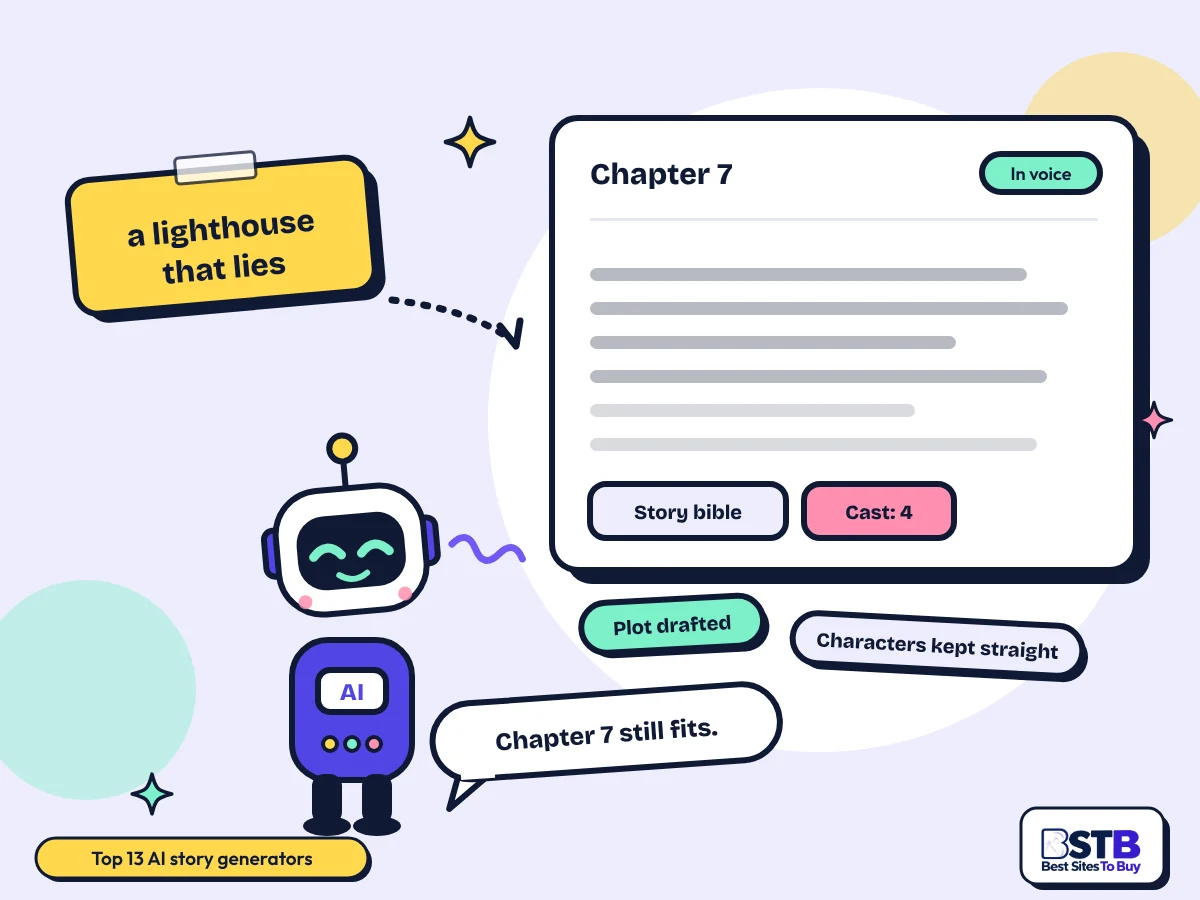
Best AI story generators: Scout the BSTB robot between a yellow idea note reading a lighthouse that lies and a chapter 7 draft marked in voice with a story bible

Why You Can Trust BSTB's AI Tool Listings

Every AI story generator on this page has its own BSTB page with a pricing model, plan prices, what it actually writes and a score from the same nine criteria.

  • One scoring method for every tool
  • Prices taken from each tool's official pages
  • Plain summaries of what the tool actually does

See how BSTB tests and scores AI tools.

The directory

Top 13 AI Story Generators, Ranked by BSTB Score

Charisma and Storyboard Hero lead at 4.0/5, though for writing prose Sudowrite and NovelAI at 3.9/5 are the stronger picks; filter by price or by what you are writing.

Show:

Showing 13 of 13. Picked from the 19 tools listed in the BSTB Storyteller category, ranked by overall score.

Charisma

4.0/5Paid

No-code story graph for interactive characters that remember what happened and react with emotion, built for studios and brands.

  • Best for: Interactive characters that remember
  • Price: PRO $5 per 50,000 credits, about 200 experience minutes; Enterprise on request; free tier unconfirmed
Read the Charisma review

AI Magicx

3.9/5Freemium

All-in-one workspace bundling chat, image, video, voice and music models, with story writing as one job among many.

  • Best for: One subscription across many jobs
  • Price: Free $0; Starter Pack $29 one-time; Pro $19/mo; Team $59/mo; lifetime plans $69 to $1,999
Read the AI Magicx review

NovelAI

3.9/5Paid

Story co-writer with a Lorebook that holds your characters and world so the model stops contradicting itself, plus image generation in the same subscription.

  • Best for: Long fiction with a memory of its own
  • Price: Paper free trial $0; Tablet $10/mo; Scroll $15/mo; Opus $25/mo; Anlas top-ups vary
Read the NovelAI review

Sudowrite

3.9/5Paid

Novelist's editor with a Story Bible plus Write, Rewrite and Expand tools, the closest thing here to a working fiction workflow.

  • Best for: Serious novelists who still write
  • Price: Free trial $0, no card; Hobby and Student $10/mo shown ($19 reported); Professional $22/mo shown ($29 reported)
Read the Sudowrite review

Makiverse

3.7/5Freemium

Turns a one-line pitch into a plotted manga, webtoon or anime episode, with the panels drawn as well as written.

  • Best for: Comics and webtoons from a pitch
  • Price: Free $0 starter credits; Basic $9.99/mo; Standard $14.99/mo (both reported), priced in Emeralds
Read the Makiverse review
iOS only

Storycraft

3.6/5Freemium

A sandbox game where you build a world and then write chapter stories inside it, closer to play than to a writing tool.

  • Best for: Writing that feels like playing
  • Price: Base game $0; starter packs from $1.99; currency bundles to $99.99
  • Status: iOS only (see review)
Read the Storycraft review

Talefy

3.4/5Freemium

Choose-your-path AI fiction app with illustrated scenes and a creator mode for writing your own branching stories.

  • Best for: Branching stories readers choose
  • Price: Free account $0; 165 Taleys $1.99; 855 Taleys $10.99; Premium on iOS $19.99 to $46.99
Read the Talefy review
The basics

What Are AI Story Generators?

AI story generators, also sold as AI storytelling tools, draft or co-write fiction. You give them an idea, a character or an unfinished passage, and they produce plot, prose or dialogue you then edit. Most are AI story generators online, running in a browser rather than as software you install.

They divide by what you are actually writing. Novel co-writers such as Sudowrite and NovelAI sit alongside a manuscript and help chapter by chapter. Planning tools such as Plot Factory work on the plot and the cast before any prose exists. Interactive tools such as Deep Realms and Talefy build branching fiction you move through. And a smaller group, like We Made A Story, writes and illustrates short pieces in one pass.

What they are genuinely good at is momentum: an opening you can react to, three plot directions instead of none, and a way past a blank page. What they are weakest at is the thing that makes fiction worth reading, which is a specific voice and a reason for the story to exist. Those stay with you.

How Do AI Story Generators Work?

You give the tool context: a premise, characters, a style and often earlier chapters. It predicts what comes next in that voice, and the better tools keep a separate memory of your world so later chapters do not contradict earlier ones.

  1. You set the context

    Premise, genre, point of view and the characters. The more specific this is, the less generic the output, and most disappointing results trace back to a thin setup.

  2. It drafts the next passage

    The model continues from what you gave it. It is predicting plausible next sentences, not following a plan, which is why it drifts over long stretches.

  3. A story memory keeps facts straight

    The strongest tools here hold a separate record of characters and world facts. This is the single feature that separates a novel tool from a chatbot.

  4. You edit, then feed it back

    Your edits become the context for the next passage. A story improves when you correct it early rather than generating ten chapters and fixing them later.

What Can You Do With an AI Story Generator?

Turn an idea into a plot, build a cast of characters, draft chapters, write dialogue, continue a manuscript you abandoned, explore alternative directions and get past a blank page.

  • Turn an idea into a plot: structure, beats and a sense of where the story is going.
  • Build a cast: characters with histories, motivations and voices that differ from each other.
  • Draft chapters: a rough pass you rewrite, which is far easier than starting from nothing.
  • Write dialogue and scenes: especially useful for the connective scenes nobody enjoys writing.
  • Continue an unfinished draft: paste in what you have and carry it forward in the same voice.
  • Get unstuck: three bad directions on the page beat one perfect one in your head.
By what you write

Best AI Story Generators by What You Are Writing

The best AI storytelling tools differ by the work. Pick by yours: a novel you are drafting, the plot and cast before the prose, branching interactive fiction, an illustrated short piece, or a wider suite where stories are one job among many.

Novels, chapters and finishing a draft

Novel and chapter co-writers, including continuing a manuscript you already started. These hold a story memory so characters stay consistent.

Interactive and roleplay fiction

Branching and roleplay fiction you move through rather than read straight, plus tools for building characters who respond.

  • Charisma: Interactive characters that remember
  • Deep Realms: Worldbuilding you can then write in
  • Storycraft: Writing that feels like playing
  • Talefy: Branching stories readers choose

Plot, characters and storyboards

AI tools to develop story plots, build a cast and storyboard visually, all of which happen before the prose does.

Illustrated short stories and comics

AI tools to write short stories with pictures: children's books, comics, manga and webtoons, written and drawn in one pass.

Wider suites with story features

Wider AI suites where story writing is one feature among many, and the usual answer for AI story generators for business. Cheaper if you need the other features too, weaker if you do not.

Know the difference

Co-Writer vs One-Click Generator

A co-writer works alongside you paragraph by paragraph and keeps your voice. A generator produces a whole draft from a brief. The first is slower and produces something publishable; the second is fast and usually reads like a machine wrote it.

Co-writerOne-click generator
How you use itParagraph by paragraph, you steeringA brief in, a draft out
Whose voiceYours, if you edit as you goThe model's default voice
Story memoryUsually a Story Bible or LorebookRarely anything persistent
Time to a draftWeeks, same as writingMinutes to hours
Honest outcomeSomething you would publishA starting point that needs a full rewrite
On this pageSudowrite, NovelAI, Plot FactoryBook AI Writer, We Made A Story, Makiverse
What to look for

What Makes a Good AI Story Generator?

A good one remembers your characters, lets you steer genre and point of view, keeps your prose rather than flattening it, exports somewhere you can actually finish the book, and is clear about what it does with your manuscript.

  • A real story memoryA Story Bible, Lorebook or codex that holds characters and world facts. Without one, chapter eight will contradict chapter two and no amount of prompting fixes it.
  • Genre, tone and point of view controlsReal settings rather than a prompt box. First person past and third limited are different machines, and a tool that cannot hold one is not usable for a novel.
  • It keeps your voiceThe test is whether output sounds like your chapter or like every other AI chapter. Tools trained on your existing text do this far better.
  • Export you can finish inWord, ePub or Scrivener. A story locked inside a web app is a story you cannot submit, format or typeset.
  • Clear terms on your manuscriptUnpublished fiction is sensitive. Check whether the tool trains on what you write, and whether a free tier reserves broader rights than a paid one.
  • Characters that sound differentGood dialogue needs two people who do not speak the same way. Per-character voice is rare and it is what separates usable dialogue from filler.

These overlap with BSTB's nine scoring criteria, which also weigh ease of use, speed, support and cost-efficiency.

Step by step

How to Write a Story With AI, Step by Step

Five steps: write the premise and cast down first, set point of view before drafting, generate one scene at a time, correct the story memory the moment it drifts, and rewrite every passage in your own voice before moving on.

  1. Write the premise and cast first

    A paragraph of premise and a line per character. This is the context everything downstream depends on, and skipping it is why most AI fiction reads as generic.

  2. Fix the point of view

    Person and tense, decided before the first draft. Switching later means rewriting everything, and AI will drift if you have not told it.

  3. Generate one scene at a time

    Not chapters, not the whole book. Short passages keep the thread and let you catch drift while it is cheap to fix.

  4. Correct the memory immediately

    When a character's eye colour, age or motivation slips, update the story bible then rather than later. Errors compound into plot holes.

  5. Rewrite in your voice

    Every passage, before you move on. A draft that is 70 percent machine and 30 percent you reads as machine; the reverse reads as yours.

Buyer checklist

How to Choose an AI Story Generator

Decide whether you want a co-writer or a finished draft, check it holds a story memory, test it on a scene you have already written, confirm you can export, and read what it does with your manuscript.

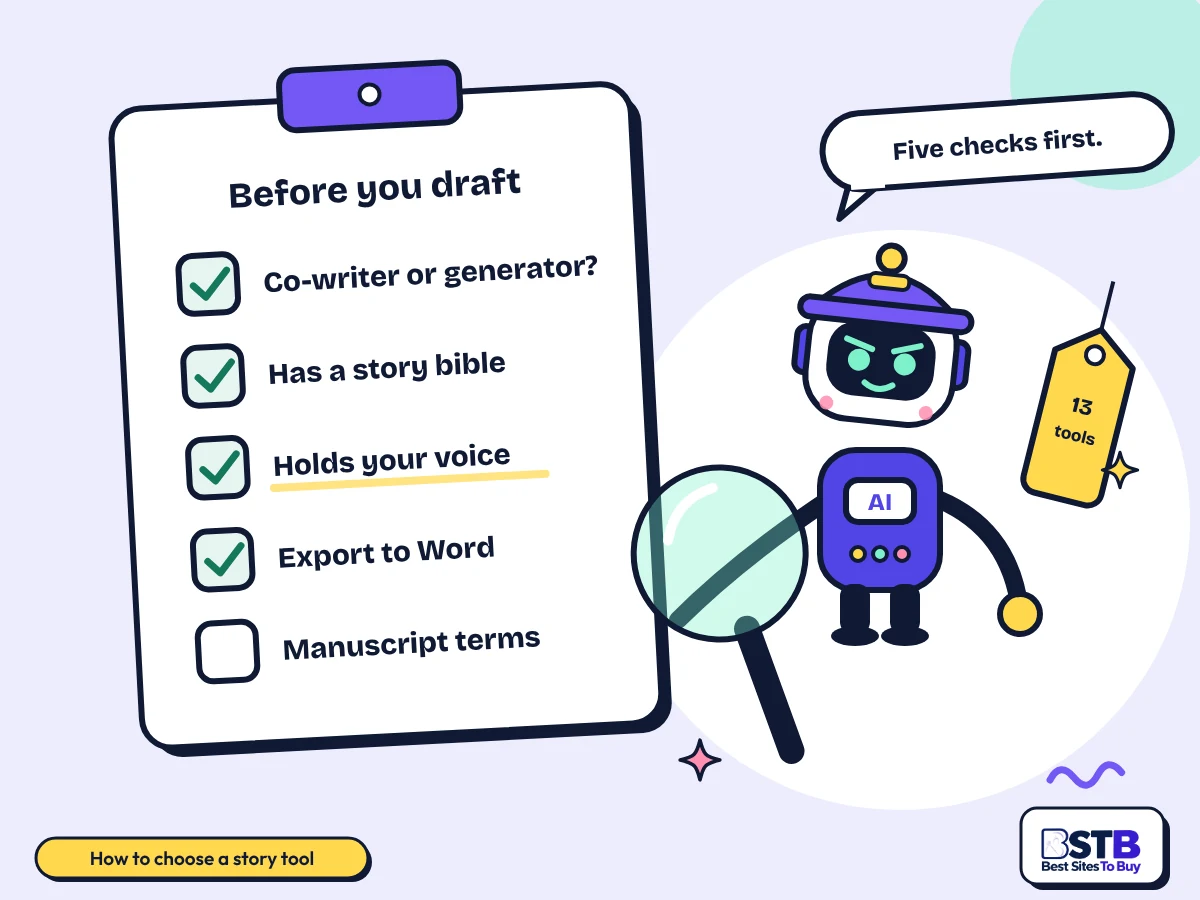
  1. Co-writer or generator

    This is the whole decision, and it is the one that separates AI story generators for beginners from tools built for working novelists. Use the filter above the grid.

  2. Check for a story memory

    Story Bible, Lorebook or codex. For anything longer than a short story this is not optional.

  3. Test on a scene you have written

    Give it your own chapter and ask for the next scene. You will know within a paragraph whether the voice holds.

  4. Confirm you can export

    Word, ePub or Scrivener. Ask before you write 60,000 words inside something.

  5. Read the manuscript terms

    Unpublished work is the most sensitive thing most writers own. Check training and retention.

How to choose an AI story generator: a checklist reading co-writer or generator, has a story bible, holds your voice, export to Word and manuscript terms
Export matters more than it sounds. Finding out at 70,000 words is too late.
Pricing

Free vs Paid AI Story Generators

Free AI story generators are the majority here: 8 of the 13 have a free tier and 5 are paid or trial only, with paid plans from about $9 to $25 a month and several priced in credits rather than a flat subscription.

Pricing modelTools in the top 30What you getTools
Free0 of 13Everything free, no paid tier
Freemium8 of 13Free plan with limits, paid upgradeAI Magicx, Plot Factory, Deep Realms, Makiverse, Storycraft, Talefy, Book AI Writer, We Made A Story
Paid5 of 13Paid only, sometimes with a trialCharisma, Storyboard Hero, NovelAI, Sudowrite, Vimerse Studio

Prices come from each tool's BSTB page. This category has the worst pricing transparency of any BSTB has audited: most tools publish figures only through third-party directories, several hide the real price behind a login, and the sources openly disagree on others. Every uncertain figure is marked reported on the card. Credit-based pricing is also common here, which makes a monthly comparison harder than it looks. Confirm on the vendor's own site before you buy.

Use with care

Limits, Craft and Who Owns the Result

AI drifts over long stretches, flattens voice, writes competent scenes with no reason to exist, and leaves you with a copyright position that is genuinely unsettled rather than simply unknown.

  • Drift over length: the longer the stretch, the more characters and facts slide. Story memory reduces this; nothing removes it.
  • Flattened voice: unedited AI prose converges on the same rhythms. Readers notice before writers do.
  • Competent and pointless: the most common failure is a scene that is technically fine and carries no weight, because nothing is at stake.
  • Dialogue sameness: characters tend to sound identical unless you deliberately write them apart.
  • Unsettled ownership: raw AI output may not attract copyright in several jurisdictions. See the FAQ below.
  • Publisher and platform rules: disclosure requirements differ by publisher, platform and competition. Check before you submit.
Our method

How BSTB Rates AI Story Generators

BSTB scores every one of these story tools on the same nine criteria, and the overall score on each card is the plain average of the nine.

  • Accuracy and Reliability
  • Ease of Use
  • Functionality and Features
  • Performance and Speed
  • Customization and Flexibility
  • Data Privacy and Security
  • Support and Resources
  • Cost-Efficiency
  • Integration Capabilities

Scores are based on each tool's official pages, documentation, pricing and public user feedback. Read the full method on how BSTB tests and scores tools.

Related AI Tool Categories

Story generators overlap with these categories. Browse them when you need a narrower tool, or go back to the full AI tools directory.

FAQs

AI Story Generators: Frequently Asked Questions

Quick answers on writing a whole story from an idea, building characters, developing a plot, controlling genre and point of view, keeping characters consistent, beating writer's block, writing dialogue and who owns the result.

Can AI Write a Complete Story From an Idea?

Yes, and the result is a draft rather than a finished story. Tools here will turn a premise into full chapters in one pass, but the output needs a rewrite before anyone else reads it.

The gap is not grammar, which AI handles. It is that a generated story tends to be competent and weightless: scenes happen, nothing is at stake, and the ending arrives because the word count did. Treat a one-click draft as raw material.

  • Book AI Writer: 3.3/5; turns a blueprint into full chapters plus cover art.
  • Makiverse: 3.7/5; a one-line pitch becomes a plotted manga or webtoon episode.
  • We Made A Story: 3.3/5; short illustrated children's stories end to end.
  • Expect to rewrite: the structure usually survives; the prose usually does not.

A complete draft in an hour is real. A complete story still takes the work it always did.

How Can I Create Characters With an AI Story Generator?

Describe who they are and what they want, then let the tool expand it. The better tools store each character in a story bible so that description governs every later chapter rather than being forgotten.

AI tools to create fictional characters all ask for a description; motivation is the field people skip and it is the one that matters. A character with a want and an obstacle generates scenes by themselves; a character with a hair colour and a job generates nothing.

  • Plot Factory: 3.9/5; built around characters and universes before prose.
  • Sudowrite: 3.9/5; Story Bible holds the cast across the manuscript.
  • Deep Realms: 3.7/5; worldbuilding with lore you then write inside.
  • Write the want: what they need, what blocks it, what they would never do.

Give every character something they want and something they are wrong about. The scenes follow.

Can AI Help Develop a Plot and Storyline?

Yes, and it is one of the strongest uses. AI is good at generating structural options quickly, which is exactly what helps when you know the premise but not the shape.

Use it to produce several directions rather than one. The value is in choosing between five plot branches you would not have thought of, not in accepting the first one, which will usually be the most predictable.

  • Plot Factory: 3.9/5; chapters, arcs and an AI plotting assistant.
  • Storyboard Hero: 4.0/5; structures a story visually as frames.
  • Ask for five: then discard four. Generating options is cheap, choosing is the work.
  • Watch for: the obvious arc. AI defaults to the most conventional structure.

Ask what could go wrong for this character, not what happens next. The second question gets dull answers.

Can I Control Genre, Tone, and Point of View?

Yes on all three, but the control varies sharply. Dedicated fiction tools offer real settings for genre, person and tense; lighter tools only take it as a prompt instruction they will drift away from.

Point of view is where drift shows fastest. A tool with no persistent setting will quietly slip from third limited into head-hopping within a few scenes, and that is tedious to repair afterwards.

  • NovelAI: 3.9/5; strong style and genre steering with persistent memory.
  • Sudowrite: 3.9/5; tone and style controls aimed at novelists.
  • Set it once: person and tense before the first draft, not after chapter five.
  • Re-check at scene breaks: drift appears at the joins more than mid-scene.

If a tool cannot hold point of view across chapters, it is a short-story tool whatever it claims.

How Do I Keep Characters Consistent Across Chapters?

Use a tool with a story memory and correct it the moment something slips. A Story Bible, Lorebook or codex holds character facts outside the conversation so chapter twelve still matches chapter two.

Without that, consistency depends on how much earlier text fits in the model's context, and eventually it does not. This is the single clearest reason to use a dedicated fiction tool rather than a general chatbot for anything novel-length.

  • NovelAI: 3.9/5; Lorebook entries govern later generation.
  • Sudowrite: 3.9/5; Story Bible covering characters, world and outline.
  • Plot Factory: 3.9/5; characters and universes stored as structured records.
  • Fix it immediately: a drifted fact becomes a plot hole three chapters later.

No competitor page explains this, and it is the question most novelists actually have.

Can AI Help Overcome Writer's Block?

Yes, and it is probably the most reliable benefit in the category. Having three imperfect options on the page is a different problem from having none, and it is a much easier one to solve.

The useful technique is asking for the thing you are stuck on specifically: the next beat, five ways this scene could end badly, or what this character would refuse to do. A general request to continue produces something you will delete.

  • Ask narrowly: the next beat, not the next chapter.
  • Generate to react: you often discover what you wanted by rejecting four alternatives.
  • Sudowrite: 3.9/5; Write and Expand are built for exactly this moment.
  • Delete freely: unused generations cost nothing. The point was getting moving.

Use it to find the next sentence, then write that sentence yourself.

Can AI Write Dialogue and Scene Descriptions?

Both, with different success rates. Scene description is reliable and often over-written. Dialogue is harder, because the default failure is every character sounding like the same articulate person.

AI tools to generate dialogue nearly all share this failure. The fix is to define voice per character: vocabulary, sentence length, what they avoid saying. Tools that store characters individually handle this noticeably better than a single prompt box, though no tool here does it automatically.

  • Define voice per character: clipped or rambling, formal or blunt, what they never say.
  • Cut description by half: AI over-describes rooms and weather by default.
  • Subtext is manual: AI writes people saying what they mean. Real dialogue rarely does.
  • Read it aloud: the fastest test of whether two characters actually differ.

If you cannot tell who is speaking with the dialogue tags removed, the dialogue is not working yet.

Who Owns the Rights to an AI-Generated Story?

The honest answer is that it is unsettled and depends on where you are and how much you wrote. In the United States, work with no human authorship cannot be registered for copyright, and the UK and EU treat it differently again.

Two practical points matter more than the theory. First, substantial human authorship is what attracts protection in most jurisdictions, so a story you genuinely rewrote stands on far firmer ground than raw output. Second, each tool's own terms assign rights differently, and a free tier sometimes reserves more than a paid one.

  • Human authorship counts: the more of the final text is genuinely yours, the stronger your position.
  • Read the tool's terms: output rights differ between tools and between tiers.
  • Disclosure is separate: publishers, platforms and competitions set their own rules.
  • Get advice if it matters: if the story is commercial, this is a question for a lawyer.

Only one of the five competing pages mentions this at all, and only in passing. If the work matters commercially, treat raw output as a draft you must substantially rewrite.

Can AI Continue an Unfinished Story I Already Started?

Yes, and the tools that do it well are the ones with a story memory. You paste in what you have, add the character and world facts, and the tool continues from your text rather than starting fresh.

AI tools to continue unfinished stories are barely covered by any competitor page, despite this being one of the most common real situations a writer is in. The quality depends almost entirely on how much context you give: the manuscript alone is not enough, because the tool cannot infer what you intended to happen next.

  • Give it the manuscript and the plan: where the story is going matters as much as where it has been.
  • Sudowrite and NovelAI: both built to work alongside existing text.
  • Expect a voice gap: the join between your prose and generated prose is visible. Rewrite across it.
  • Work scene by scene: continuing 500 words at a time holds the voice far better.

Paste the last chapter, not the whole book. Recent context steers the voice more than distant context does.

How Long a Story Can AI Write, and Can I Export It?

Most tools generate a scene or a chapter at a time rather than a whole book in one pass, and export varies enormously. Some give you Word or ePub; others keep the text inside a web app.

Export is the question writers forget to ask and regret later. A 70,000-word manuscript locked inside a tool with no export is a manuscript you cannot format, submit or take to a different tool when the subscription ends.

  • Generated per scene: not per book, in practically every tool here.
  • Ask about export: Word, ePub or Scrivener, before you commit a manuscript.
  • Credit limits bite: several tools here meter by credits, which caps length per month.
  • Keep a copy outside: your manuscript should never exist only inside one vendor.

Export before you need it. Finding out at 70,000 words is too late.

Do I Have to Disclose That I Used AI?

It depends on where the story is going, and the rules are tightening. Several self-publishing platforms now ask you to declare AI involvement, and many magazines, competitions and publishers have explicit policies.

No competitor page covers this. The requirement is usually disclosure rather than prohibition, and the penalty for not disclosing where it was required is far worse than disclosing where it was not.

  • Self-publishing platforms: several now ask about AI content at upload.
  • Magazines and competitions: many ban AI-assisted entries outright. Check each one.
  • Traditional publishers: policies vary and are usually in the contract.
  • When unsure, disclose: the downside of disclosing is far smaller than being found out.

Check the specific policy of wherever the story is going, before you submit rather than after.

Can AI Write a Story in a Language Other Than English?

Most tools will attempt it and quality drops sharply outside the major European languages. Fiction is harder than general text because idiom, register and rhythm carry the writing.

The gap is widest exactly where it matters: a tool can produce grammatically correct prose in your language that no native reader would describe as good writing. Test with a passage you can judge before committing.

  • Test in your language: with a scene you have already written yourself.
  • Idiom is the weak point: literal translation of English rhythm reads badly everywhere.
  • Dialogue suffers most: register and slang are where non-English output falls apart.
  • Check the tool's claims: a language list is not the same as usable fiction in it.

Grammatically correct and worth reading are different standards. Only you can judge the second.

Is ChatGPT Enough, or Do I Need a Dedicated Story Tool?

For a short story, a general assistant is often enough. For anything novel-length, a dedicated tool wins on one feature: persistent story memory that keeps your characters and world straight across chapters.

This is the comparison readers actually want and no competitor page makes it. A general chatbot has no durable record of your world, so consistency depends on what fits in context. Dedicated tools store it separately, which is the whole difference.

  • Short fiction: a general assistant is usually fine and cheaper.
  • Novel length: story memory becomes the deciding feature, not prose quality.
  • Structured planning: Plot Factory and similar beat a chat window for cast and arcs.
  • Interactive fiction: branching tools do something general chatbots do not.

Prose quality between tools is closer than the marketing suggests. Memory and workflow are what differ.

How Does BSTB Score AI Story Generators?

BSTB scores every story tool on nine criteria: accuracy and reliability, ease of use, functionality, performance, customisation, data privacy, support, cost-efficiency and integrations.

The score on each card is the plain average of those nine. All 19 tools listed in this category were checked individually, and 13 are on this page. Scores on the category listing cards all show 0.0 and are never used for ranking.

  • Nine criteria: each scored separately, then averaged.
  • 19 listed, 19 checked: nothing on this page was estimated.
  • Ranking here: ordered by overall score, ties alphabetically.
  • Full method: see how BSTB tests and scores tools.

Scores in this category are tightly bunched, so read the filter group and the summary as well as the number.

How Often Is This List of AI Story Generators Updated?

BSTB rechecks this list whenever a tool changes its pricing, plans or availability, and reviews the whole category on a rolling basis as new tools are listed.

Pricing is the weak point in this category: most tools here publish figures only through third-party directories, and several hide the real price behind a login. Each tool's own BSTB page carries the last checked figures and says where they came from.

  • Rolling review: rechecked as tools launch, change price or disappear.
  • Status flags: shown on the card when availability is limited or unconfirmed.
  • Per-tool pages: the detail lives on each tool's own review page.
  • Spotted a change: tell us through the contact page.

Where a price is marked reported, confirm it with the vendor before subscribing.

Psst! Built an AI story tool?

Get Your AI Story Generator Listed on BSTB

Send us your tool's name, website and pricing. The BSTB team reviews every submission before it joins the AI tools directory.

List your AI story generator on BSTB: a rocket labelled BSTB-1 carrying Scout towards a directory card with a freemium badge and a nine point score
On this page