Best AI Fitness Apps 2026: AI Workout Planners - BSTB

7 tools

7 Best AI Fitness Apps for Workout Plans, Strength, Cardio and Progress Tracking

AI fitness tools build workout plans around your goal and equipment, adjust them as you log sessions, and track your progress. This page ranks the 7 best AI fitness apps on BSTB by their 9-criterion score, with what each one plans, what it tracks, and what it costs.

Top 7 of 14 tools 4 of 7 free to start
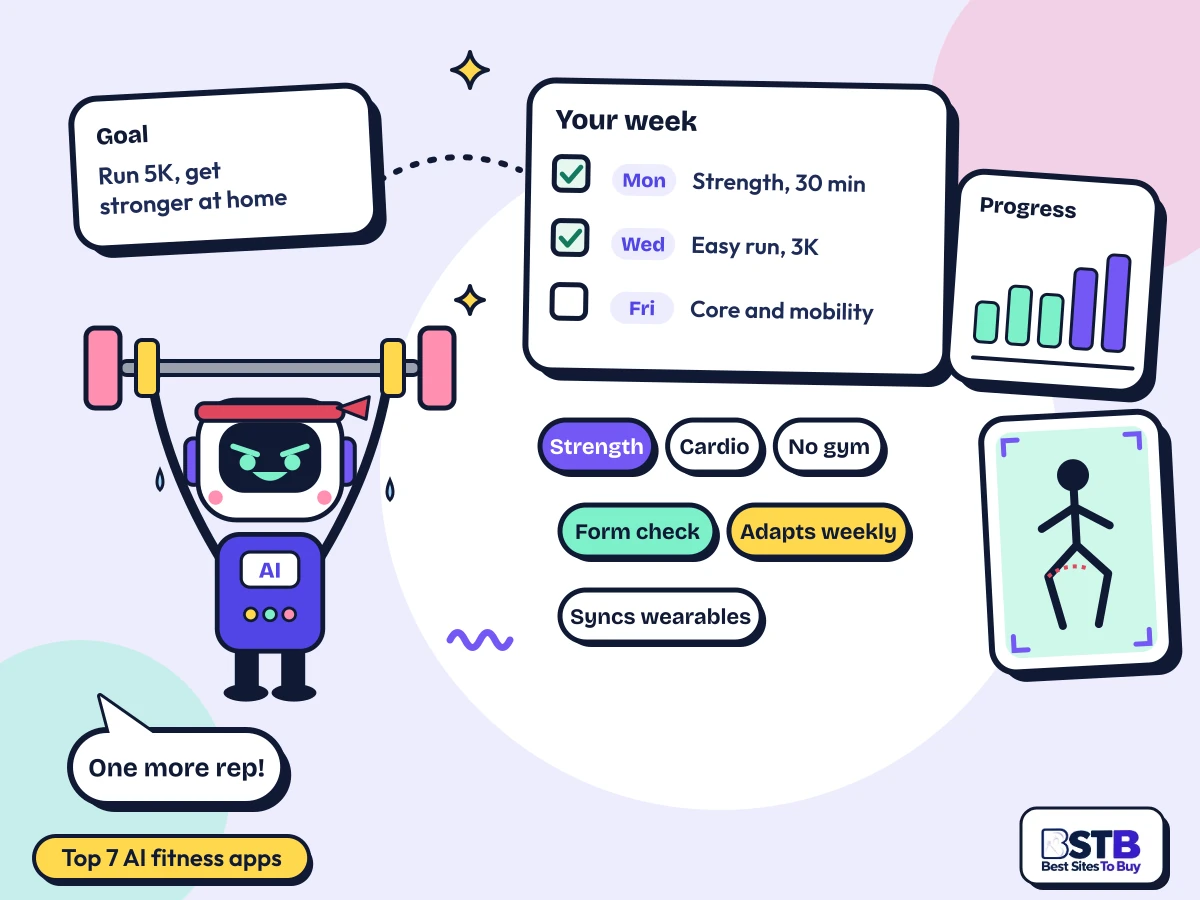
Best AI fitness apps: Scout the BSTB robot lifting a dumbbell beside a weekly workout plan, a progress chart and a phone checking form

Why You Can Trust BSTB's AI Tool Listings

Every one of these AI fitness apps has its own BSTB page with a pricing model, plan prices, the data it collects, and a score from the same nine criteria. Seven other tools tagged fitness were left off because they plan meals or habits, not workouts.

  • One scoring method for every tool
  • Prices taken from each tool's official pages
  • Plain summaries of what the tool actually does

See how BSTB tests and scores AI tools.

The directory

Top 7 AI Fitness Apps, Ranked by BSTB Score

Zing Coach leads at 4.2/5 and Freeletics follows at 4.0/5; filter the best AI fitness tools by price or by the goal you train for.

Show:

Showing 7 of 7.

Consumer site now B2B

Zing Coach

4.2/5Paid

Workout app that builds home or gym plans, follows your movement through the phone camera, estimates body composition and tunes intensity after each session.

  • Best for: Personalized plans with camera form checks
  • Price: Free download; Premium $18.99 to $59.99 (reported)
Read the Zing Coach review

Freeletics

4.0/5Freemium

App whose AI coach builds and reshapes training plans across bodyweight HIIT, gym lifting and running based on goals, level, schedule and kit.

  • Best for: Adaptive strength, HIIT and running plans
  • Price: Free plan; Training Coach $34.99 to $79.99 per term (reported)
Read the Freeletics review

Fitbod

3.9/5Paid

Strength-training planner that builds sessions around goal, kit and muscle recovery, then raises loads based on each logged set.

  • Best for: Strength workouts that adapt as you log
  • Price: Free trial; $15.99/mo or $95.99/yr
Read the Fitbod review
Wearable required

Whoop

3.9/5Paid

Screenless wrist band on an annual membership that scores recovery, sleep and strain, with an AI coach answering questions about your own data.

  • Best for: Strain, recovery and training load tracking
  • Price: One-month trial; One $199/yr (reported)
Read the Whoop review

Dr. Muscle

3.8/5Freemium

Strength app that writes gym sessions and resets sets, reps and loads after every workout using periodisation, reps-in-reserve and auto deloads.

  • Best for: Auto-adjusting strength programmes
  • Price: Free plan; 14-day trial; $49.99/mo (reported)
Read the Dr. Muscle review
Hobby project

PPLEGPT

3.1/5Free

Hobby web toy that suggests a single gym exercise for a push, pull or legs day from a short self-description.

  • Best for: Free push, pull, legs exercise ideas
  • Price: Free, no account
Read the PPLEGPT review
The basics

What Are AI Fitness Tools?

AI fitness tools are apps that plan your workouts from your goal, level and equipment, adjust the plan as you log sessions, and track your progress over time.

Most AI fitness apps work like a coach in your pocket. You answer questions about your goal, experience, available days and equipment, and the app writes a plan. Fitbod and Dr. Muscle then set weights and reps for each strength session and change them based on what you lifted last time. Freeletics covers strength, HIIT and running in one coach, and Zing Coach adds camera checks of your movement.

A second type tracks rather than plans. Whoop is a wearable that measures strain, sleep and recovery and suggests how hard to train, but it does not write workout routines. Most AI fitness tools online are phone apps first; Dr. Muscle's browser version is still in early access.

The category on BSTB is smaller than its tag count suggests. Of the 14 tools tagged fitness, only 5 generate a personalized workout plan. Four are meal planners or recipe tools, two are generic goal or habit tools, and one has pivoted to nutrition coaching. None of those are on this page.

How Do AI Fitness Apps Work?

They ask about your goal, level and equipment, generate a plan, then use what you log or what a wearable measures to adjust the next workout.

  1. You set a goal

    Strength, fat loss, a first 5K, or general fitness, plus your days and equipment.

  2. It writes a plan

    Exercises, sets, reps, weights or run intervals for each session.

  3. You train and log

    The app records what you did, or a wearable records heart rate and effort.

  4. It adjusts

    The next session gets harder, easier or different based on your results.

What Can You Do With AI Fitness Apps?

Get a personalized workout plan, build strength routines, train at home without equipment, plan runs, track lifts and recovery, and check your exercise form with a phone camera.

  • Personalized plans: a programme built for your goal, level and schedule.
  • Strength routines: weights and reps set for you, session by session.
  • Home workouts: bodyweight plans with no gym or equipment.
  • Running plans: interval and distance sessions, in one app on this page.
  • Progress tracking: lifts, volume, streaks, heart rate and recovery.
  • Form checks: camera movement tracking, in one app on this page.
By goal

Best AI Fitness Apps by Goal

Pick by what you train for: personalized plans, strength, running and cardio, progress tracking, home workouts, or a free plan. Apps that do several jobs well appear in more than one group.

Personalized workout plans

AI tools to create personalized workout plans from your goal, level and equipment, then adjust them as you train.

  • Zing Coach: Personalized plans with camera form checks
  • Freeletics: Adaptive strength, HIIT and running plans
  • GymBuddy AI: Cheap personalized routines and logging

Strength training

AI tools to build strength training routines, from full programmes that set weights and reps to single exercise ideas.

  • Fitbod: Strength workouts that adapt as you log
  • Dr. Muscle: Auto-adjusting strength programmes
  • PPLEGPT: Free push, pull, legs exercise ideas

Running and cardio

AI tools to plan running and cardio workouts. Only Freeletics builds running plans; Whoop measures cardio strain and recovery.

  • Freeletics: Adaptive strength, HIIT and running plans
  • Whoop: Strain, recovery and training load tracking

Progress and performance

AI tools to track exercise progress and AI tools to analyze fitness performance, from logged lifts to heart rate and recovery.

  • Fitbod: Strength workouts that adapt as you log
  • Whoop: Strain, recovery and training load tracking
  • Dr. Muscle: Auto-adjusting strength programmes

Home and no equipment

Bodyweight and home workouts with no gym needed. A good starting point for AI fitness tools for beginners.

  • Zing Coach: Personalized plans with camera form checks
  • Freeletics: Adaptive strength, HIIT and running plans
  • GymBuddy AI: Cheap personalized routines and logging

Free to use

Free AI fitness tools with a lasting free plan, not only a trial.

  • GymBuddy AI: Cheap personalized routines and logging
  • PPLEGPT: Free push, pull, legs exercise ideas
Know the difference

AI Workout Planners vs AI Fitness Trackers

A workout planner tells you what to do next. A fitness tracker measures what your body did. Planners suit people who want a programme; trackers suit people who already train and want feedback.

Workout plannerFitness tracker
Main jobWrites and adjusts your sessionsMeasures effort, sleep and recovery
You needA phone and the time to log setsA wearable on your wrist or body
Best forBeginners and anyone without a coachPeople who already train regularly
Adjusts your planYes, from logged resultsSuggests how hard to train today
Typical costFree plan, or about $4 to $50 a monthAbout $199 to $359 a year
On this pageFitbod, Freeletics, Dr. Muscle, Zing CoachWhoop

Many planners also read data from wearables: 7 of the 14 tools tagged fitness connect to a wearable or health app.

What to look for

What Makes a Good AI Fitness App?

A good one personalizes the plan, adapts it from your results, tracks progress clearly, states what data it collects, and lets you try it free first.

  • Real personalizationQuestions about goal, level, days and equipment, not a fixed template. 5 of 14 tools build a personalized plan.
  • Adapts as you trainWeights, reps or sessions change from what you logged. 4 of 14 say they adapt.
  • Clear progress trackingLifts, volume, streaks or heart rate over time. 8 of 14 track progress.
  • Open about dataStates what it collects: health, location, camera, wearables. 10 of 14 say what they collect.
  • A safety noteAdvises checking with a doctor before starting. 12 of 14 include one.
  • A free plan or trial13 of 14 offer one. Test the plan on your own goal before paying.

These overlap with BSTB's nine scoring criteria, which also weigh ease of use, support and integrations.

Step by step

From Goal to First AI Workout, Step by Step

Set one clear goal, answer the setup questions honestly, start lighter than you think, log every session, and let the app adjust for two to four weeks before judging it.

  1. Pick one goal

    Strength, a first 5K, fat loss or general fitness. One goal gives a clearer plan.

  2. Answer honestly

    Your real level, days and equipment. Overstating them gives a plan that is too hard.

  3. Start light

    Use easier weights in the first week while the app learns your level.

  4. Log everything

    Sets, reps, weights and how hard it felt. The plan adapts only from what you log.

  5. Review after a few weeks

    Check the progress charts, then raise or lower the goal.

Buyer checklist

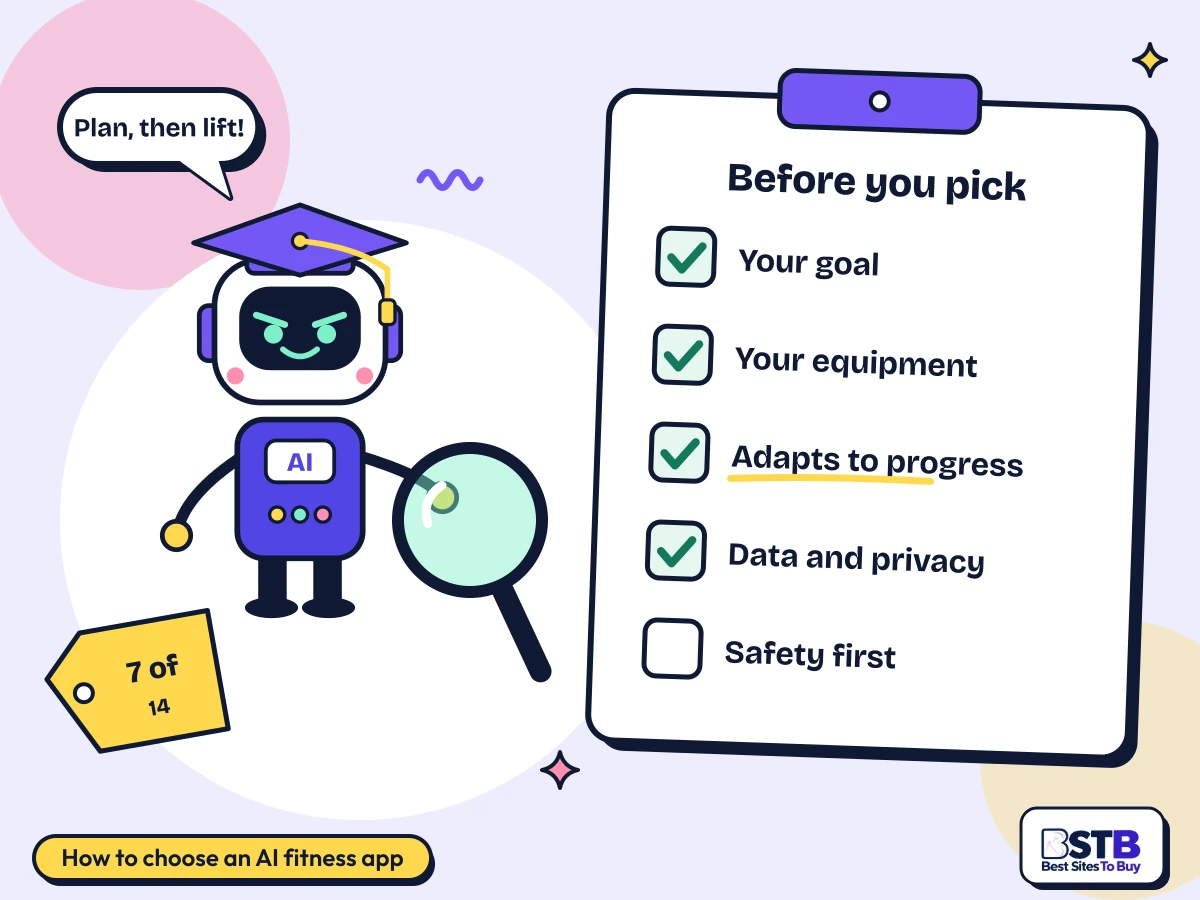
How to Choose an AI Fitness App

Match the app to your goal and equipment, check that it adapts to your progress, read what data it collects, and try the free plan or trial before paying.

  1. Your goal

    Strength apps differ from running apps. Only 1 of 14 builds running plans.

  2. Your equipment

    Gym, dumbbells at home, or none. 5 of 14 handle no-equipment workouts.

  3. Adapts to progress

    The plan should change as you log. 4 of 14 say they adapt.

  4. Data and privacy

    Check what it collects and whether it needs a wearable or your camera.

  5. Safety first

    Check with a doctor first if you have an injury or health condition.

How to choose an AI fitness app: a checklist reading your goal, your equipment, adapts to progress, data and privacy and safety first
Match the app to your goal, then try it free.
Pricing

Free vs Paid AI Fitness Apps

Free AI fitness tools are enough to start: 4 of the 7 apps here have a lasting free plan and 2 more offer a trial. Paid plans add full programmes, adaptation and detailed tracking.

Costs vary widely. GymBuddy AI is reported at 3.99 euros a month, Fitbod is $15.99 a month or $95.99 a year, and Dr. Muscle is reported at $49.99 a month. Freeletics sells 3, 6 or 12-month terms from $34.99 to $79.99. Whoop is a yearly membership from $199 that includes the wearable. PPLEGPT is free with no account.

Pricing modelTools on this pageWhat you getTools
Free1 of 7Everything free, no paid tierPPLEGPT
Freemium3 of 7Free plan with limits, paid upgradeFreeletics, GymBuddy AI, Dr. Muscle
Paid3 of 7Paid only, sometimes with a trialZing Coach, Fitbod, Whoop

Prices come from each tool's BSTB page; only Fitbod's is confirmed. Two cautions. Trials often renew automatically into a paid plan. And in-app prices can differ by country and app store.

Use with care

Limits and Safety of AI Fitness Apps

AI fitness apps cannot see injuries or health conditions you do not tell them about, rarely check your form, and offer no human coach. Use them as a guide, not medical advice.

  • Not medical advice: check with a doctor before starting if you have an injury, a health condition, or are pregnant.
  • Form is rarely checked: only 1 of 14 tools checks movement by camera.
  • No human coach: 0 of 14 offer access to a human coach.
  • Plans depend on your logs: skipped or inaccurate logging gives a worse plan.
  • Running is thin: only 1 of 14 builds running plans.
  • Data is personal: health, location and camera data deserve a careful read of the privacy policy.
Our method

How BSTB Rates AI Fitness Apps

BSTB scores every one of these AI fitness apps on the same nine criteria, and the overall score is the mean of the nine.

  • Accuracy and Reliability
  • Ease of Use
  • Functionality and Features
  • Performance and Speed
  • Customization and Flexibility
  • Data Privacy and Security
  • Support and Resources
  • Cost-Efficiency
  • Integration Capabilities

Scores are based on each tool's official pages, app store listings, published pricing and hands-on checks where available. For fitness apps, personalization, how well the plan adapts, and data privacy weigh most. Every overall score on this page matches the mean of its nine criteria to one decimal, checked in code for all 14 tools in the category. Read more about how BSTB tests and scores tools.

Related AI Tool Categories

AI fitness tools overlap with these categories. Browse them or see the full AI tools directory.

FAQs

AI Fitness Apps: Frequently Asked Questions

Quick answers on personalized plans, adapting to goals, camera form checks, strength and cardio, progress tracking, home workouts, reliability and the data these apps collect.

Can AI create a personalized workout plan?

Yes. Five of the 14 tools tagged fitness on BSTB build a personalized workout plan from your goal, level, schedule and equipment.

Zing Coach, Freeletics, Fitbod, Dr. Muscle and GymBuddy AI all ask setup questions and write a plan from the answers. The more honest your answers, the better the plan fits.

  • Goal: strength, running, fat loss or general fitness.
  • Level: beginner, intermediate or advanced.
  • Schedule: days per week and session length.
  • Equipment: gym, dumbbells or none.

How can AI adapt workouts to my fitness goals?

It changes weights, reps, sessions or difficulty based on what you log and how hard you found it. Four of the 14 tools say they adapt plans this way.

Fitbod and Dr. Muscle adjust the next strength session from the weights and reps you completed. Freeletics and Zing Coach adapt their plans as you train and log progress. If you change your goal, update it in the app so the plan follows.

No competitor explains how the adaptation actually works.

Can AI track exercise form using a camera?

Yes, but it is rare. Only Zing Coach, 1 of the 14 tools tagged fitness, tracks your movement through the phone camera.

Zing Coach uses camera movement tracking during workouts. Prop the phone where your whole body is in frame, in good light. Camera checks help with basic positions but cannot replace a qualified coach watching complex lifts.

Competitors mention camera form checks only in page body text, not as a question.

Can AI help plan strength and cardio training?

Yes, though few apps do both. Freeletics plans strength, HIIT and running together; most other apps on this page focus on strength.

Freeletics is the only tool in the category with running plans. Fitbod, Dr. Muscle and PPLEGPT focus on strength. Whoop does not plan sessions but measures cardio strain and recovery, which helps you decide how hard to train each day.

No competitor covers combined strength and cardio planning.

How do AI fitness apps track progress?

They record what you log, such as weights, reps, sessions and streaks, and many also read heart rate, sleep and activity from a wearable or health app.

Eight of the 14 tools track progress. Fitbod and Dr. Muscle chart strength gains from logged lifts. Whoop tracks strain, sleep and recovery from its wearable. Seven of the 14 connect to a wearable or health app.

  • Logged lifts: weights, sets and reps.
  • Consistency: sessions and streaks.
  • Body signals: heart rate and sleep from a wearable.
  • Trends: charts over weeks and months.

Can AI create workout plans without gym equipment?

Yes. Five of the 14 tools tagged fitness build home or no-equipment plans, and all five apps on this page that write full plans can do it.

Freeletics, Zing Coach, GymBuddy AI, Fitbod and Dr. Muscle can plan bodyweight or home workouts. Tell the app exactly what you have, even a single pair of dumbbells or a resistance band, so it can add load as you get stronger.

Are AI-generated workout recommendations reliable?

They are a reasonable starting point for healthy adults, but not medical advice. They cannot see injuries, pain or conditions you do not report, and only one app here checks form.

The plans follow common training principles and improve as you log. Treat them as a guide: stop if something hurts, start lighter than suggested, and check with a doctor or physiotherapist first if you have an injury, a health condition or are pregnant. Twelve of the 14 tools include a safety note saying the same.

This is general information, not medical advice.

What fitness data do AI apps collect?

Usually your profile, goals, workouts and progress, and often health data from wearables, plus camera or location data when those features are on. Ten of 14 tools state what they collect.

Expect age, height, weight, goals and training history. Apps that connect to wearables or health apps read heart rate, sleep and activity. Zing Coach uses the camera for movement tracking. Read the privacy policy, switch off permissions you do not need, and check whether you can delete your data.

  • Profile: age, height, weight, goals.
  • Training: workouts, sets, reps, weights.
  • Health signals: heart rate, sleep, activity.
  • Device: camera and location, if enabled.

Competitors cover this only in body text, not as a question.

Can an AI fitness app replace a personal trainer?

Not fully. None of the 14 tools tagged fitness offers a human coach, and only one checks form, so a trainer is still better for technique, injuries and motivation.

AI apps are cheaper and always available, and they handle planning and progression well. A good option is a few sessions with a trainer to learn technique, then an app to plan and track between sessions.

Do AI fitness apps work with smartwatches and wearables?

Many do. Seven of the 14 tools tagged fitness connect to a wearable or health app, and Whoop is built around its own wearable.

Freeletics, Fitbod, Dr. Muscle and Zing Coach connect to wearables or health apps on BSTB's data. Check the app store listing for your exact watch or platform before paying.

No competitor answers wearable sync as a question.

Are there AI fitness tools for business, gyms or trainers?

A few. Three of the 14 tools tagged fitness mention business use, and Zing Coach is the only workout app on this page with a partner programme for businesses.

Zing Coach's consumer site now points to its business partner page. Business pricing is not listed, so contact the vendor. Gyms and trainers comparing AI fitness tools for business should ask about client data, branding and how plans are shared.

How does BSTB score AI fitness apps?

Every tool is scored from 1 to 5 on nine criteria, and the overall score is the mean of the nine. Personalization and data privacy matter most here.

The nine criteria are Accuracy and Reliability, Ease of Use, Functionality and Features, Performance and Speed, Customization and Flexibility, Data Privacy and Security, Support and Resources, Cost-Efficiency and Integration Capabilities. Read more about how BSTB tests and scores tools.

Card ratings on the category listing show 0.0 because they count user reviews. The editorial score on each tool's page is the one used here.

How often is this list of AI fitness apps updated?

The list is reviewed regularly and whenever an app changes its pricing, is renamed, or shuts down. Status badges on the cards flag recent changes.

Fitness apps change plans and prices often, and several tools tagged fitness have pivoted to other products. If you spot an out-of-date price or an app that should be listed, tell the team through the contact page.

Where a price is marked reported, confirm it in the app store before subscribing.

Get it listed here.

Get Your AI Fitness App Listed on BSTB

Send us your app's name, website and pricing. The BSTB team reviews every submission before it joins the AI tools directory.

List your AI fitness app on Best Sites To Buy: the BSTB-1 rocket flying past a dumbbell towards a tool card
On this page