Best AI Marketing Tools 2026: Free & Paid Software - BSTB

Psst! 51 marketing tools inside

51 Best AI Marketing Tools in 2026 for Content, SEO, Social, Email, Ads and Analytics

AI marketing tools cover nine jobs that used to need nine people: writing the content, winning the search result, posting to social, sending the email, cutting the video, building the ad creative, designing the assets, wiring it all together and telling you what worked. This page ranks the 51 best AI marketing tools on BSTB by their 9-criterion score, each with its pricing model, channel and a plain-English summary.

Top 51 of 218 tools 19 of 51 free to start
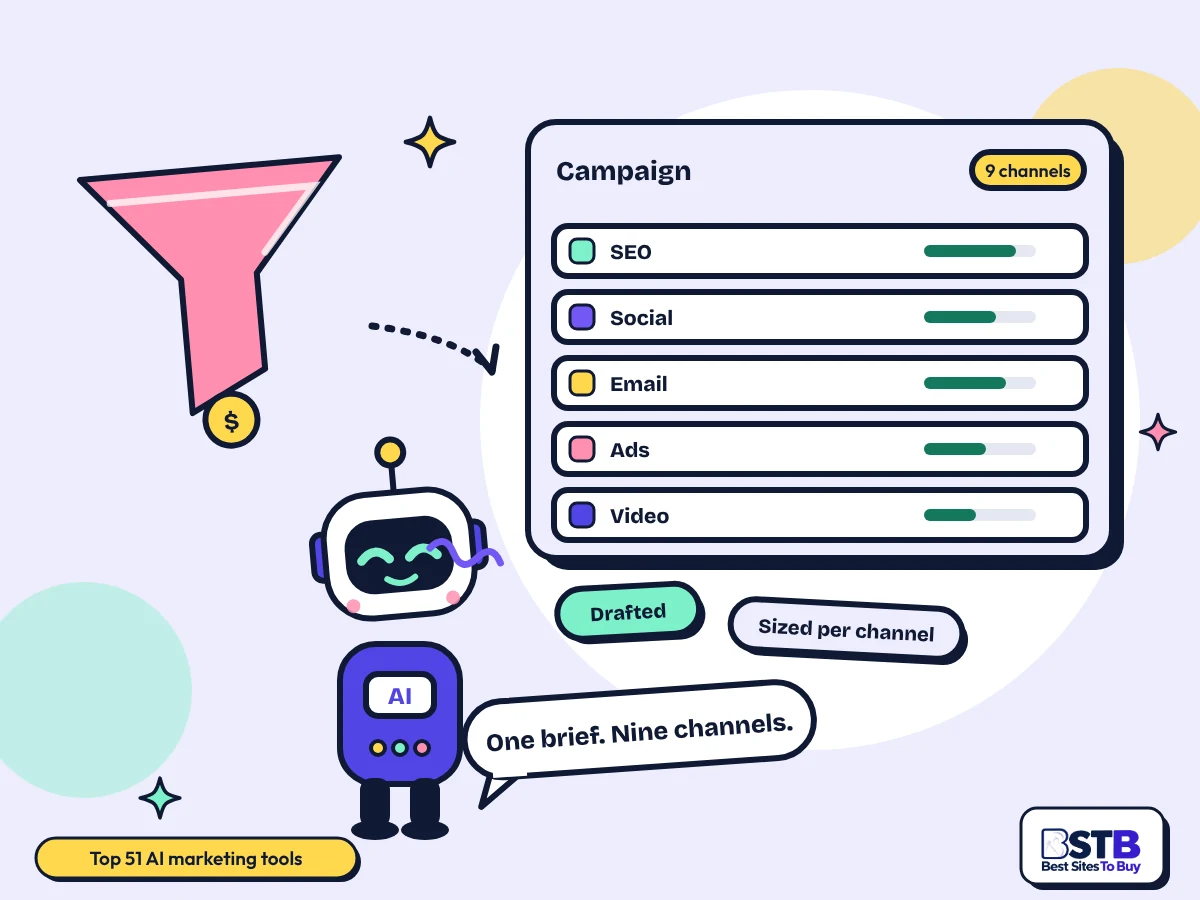
Best AI marketing tools: Scout the BSTB robot beside a campaign panel listing SEO, social, email, ads and video channels with progress bars

Why You Can Trust BSTB's AI Tool Listings

Every AI marketing tool on this page has its own BSTB page with a pricing model, plan prices, the channel it works on and a score from the same nine criteria.

  • One scoring method for every tool
  • Prices taken from each tool's official pages
  • Plain summaries of what the tool actually does

See how BSTB tests and scores AI tools.

The directory

Top 51 AI Marketing Tools, Ranked by BSTB Score

Make leads at 4.3/5, with HubSpot, Lebesgue, Sprout Social and Stripo at 4.2/5; filter by price or by the channel you are trying to fix.

Show:

Showing 51 of 51. Picked from the 218 tools listed in the BSTB Marketing category, ranked by overall score.

Previously sold as Integromat

Make

4.3/5Freemium

Visual automation that wires a marketing stack together, now with AI agents running steps inside the scenarios.

  • Best for: Joining tools that do not talk
  • Price: Free $0; Core $9/mo annual ($10.59 monthly, reported); Pro $16/mo annual (reported); Teams and Enterprise higher
  • Status: Previously sold as Integromat (see review)
Read the Make review
Products rebranded regularly

HubSpot

4.2/5Freemium

CRM and marketing hub with the Breeze AI layer drafting content, running agents and enriching records.

  • Best for: One system of record for marketing
  • Price: Free $0; Starter from $7/seat/mo annual ($20 monthly); Professional from $90/seat/mo; Enterprise higher
  • Status: Products rebranded regularly (see review)
Read the HubSpot review

Lebesgue

4.2/5Freemium

Joins store, ad and competitor data into one ecommerce marketing dashboard with recommendations attached.

  • Best for: Ecommerce marketing in one view
  • Price: Free $0; Analytics Advanced $59/mo; Ultimate $79/mo; Ultimate AI $149/mo; Le Pixel varies, unconfirmed
Read the Lebesgue review

Stripo

4.2/5Freemium

Builds responsive email templates and exports them to more than 90 email platforms, so it fits whatever you already send with.

  • Best for: Email design without changing ESP
  • Price: Free $0; Basic $20/mo ($200/yr); Medium $45/mo ($450/yr); Pro $125/mo ($1,250/yr)
Read the Stripo review
Some AI features reported in beta

Drafts emails, builds automations and suggests segments from inside ActiveCampaign rather than as a bolt-on.

  • Best for: Automation-led email programmes
  • Price: 14-day free trial; Starter from $15/mo (reported); Plus and Pro tiers reported, unconfirmed
  • Status: Some AI features reported in beta (see review)
Read the ActiveCampaign AI review

Anyword

4.1/5Paid

Writes ads, emails and landing copy and scores each version against predicted performance before you publish it.

  • Best for: Choosing between variants on data
  • Price: Starter $49/mo ($39 yearly); Data-Driven $99/mo ($79 yearly); Business and Enterprise custom
Read the Anyword review
Ownership in transition to BlueConic

Blueshift

4.1/5Paid

Runs personalised email, SMS, push and web campaigns from a single customer profile, priced for larger programmes.

  • Best for: Cross-channel personalisation
  • Price: Starter from $1,250/mo billed annually; Growth and Enterprise custom quote
  • Status: Ownership in transition to BlueConic (see review)
Read the Blueshift review

BrightEdge

4.1/5Paid

Enterprise SEO with AI-search visibility tracking, built for in-house search teams rather than individual writers.

  • Best for: In-house enterprise SEO teams
  • Price: Enterprise platform, custom quote after a demo; no free plan or trial
Read the BrightEdge review

Buffer

4.1/5Freemium

Low-cost social scheduler with an AI assistant, analytics and a comment inbox, priced per channel rather than per seat.

  • Best for: Paying only for channels you use
  • Price: Free $0; Essentials $5 per channel/mo ($60/channel/yr); Team $10 per channel/mo
Read the Buffer review
Folding into Fullcast Propel

Copy.ai

4.1/5Paid

Go-to-market workflows and agents that draft marketing and sales content against a defined process rather than a prompt.

  • Best for: Repeatable go-to-market workflows
  • Price: Chat $29/mo ($24 annual); Growth $1,000/mo ($12,000 yearly); Expansion $2,000/mo
  • Status: Folding into Fullcast Propel (see review)
Read the Copy.ai review
Plan names and prices have changed

Creatify

4.1/5Freemium

Turns product links and scripts into video and image ads sized for social feeds, using AI actors for UGC-style creative.

  • Best for: UGC-style ads without a creator
  • Price: Free $0; Starter $39/mo; Pro $99/mo; Enterprise custom
  • Status: Plan names and prices have changed (see review)
Read the Creatify review

Frase

4.1/5Paid

SERP research, content scoring and answer-engine checks in one writing workspace, aimed at briefs as much as drafts.

  • Best for: Briefs and drafts in one place
  • Price: 7-day free trial; Starter $39/mo yearly ($49 monthly); Professional $103/mo yearly; Scale higher
Read the Frase review
OwlyWriter AI now Wisdom AI

Hootsuite

4.1/5Paid

Schedule, monitor and report across every brand channel, the long-standing suite with AI drafting added.

  • Best for: Many brands, many channels
  • Price: 14-day free trial; Standard from $99/user/mo annual; Professional from $199/user/mo; Advanced higher
  • Status: OwlyWriter AI now Wisdom AI (see review)
Read the Hootsuite review

Kittl

4.1/5Freemium

Browser design editor with templates plus AI image, vector and video tools, stronger on craft than most marketing design tools.

  • Best for: Design-led brand assets
  • Price: Free $0; Pro $12 per editor/mo annual; Expert $26 per editor/mo; Max $48 per editor/mo
Read the Kittl review

PosterMyWall

4.1/5Freemium

Designs posters, social posts, videos and emails from templates, built for small business promotions rather than brand systems.

  • Best for: Small business promo material
  • Price: Free $0; Premium $13/mo ($109/yr); Premium Plus $30/mo ($319/yr); pay per download $5.99 to $14.95
Read the PosterMyWall review
Standard plan lists beta features

ProductAI

4.1/5Freemium

Turns plain product images into styled campaign photos and short videos, aimed at ecommerce listings and ads.

  • Best for: Product shots without a studio
  • Price: Free start EUR 0; Basic EUR 16/mo (EUR 8 first month); Standard EUR 29/mo; Pro higher
  • Status: Standard plan lists beta features (see review)
Read the ProductAI review

SocialBee

4.1/5Paid

Category-based scheduling across ten networks with AI post writing, built around recycling evergreen content.

  • Best for: Recycling evergreen posts
  • Price: Bootstrap $29/mo ($24.20 annual); Accelerate $49/mo ($40.80 annual); Pro $99/mo
Read the SocialBee review
Older Pro plan reported retired

vidIQ

4.1/5Freemium

YouTube keyword research with title and thumbnail scoring, the main option if YouTube is a marketing channel for you.

  • Best for: YouTube as a marketing channel
  • Price: Free $0; Boost reported $39/mo or $199/yr; Max reported $39/mo yearly; coaching tiers higher
  • Status: Older Pro plan reported retired (see review)
Read the vidIQ review
Now agency-only, self-serve withdrawn

Akkio

4.0/5Paid

Turns campaign data into audience plans and client-ready reports, now sold to agencies rather than self-serve users.

  • Best for: Agencies reporting to clients
  • Price: Enterprise custom quote; no public pricing and no free trial
  • Status: Now agency-only, self-serve withdrawn (see review)
Read the Akkio review
Meta ads reported in beta

Blaze

4.0/5Paid

Plans, writes and publishes social posts, blogs, emails and ads from one brand voice rather than per channel.

  • Best for: One voice across every channel
  • Price: Starter $79/mo; Growth $149/mo; All-In-One $999/mo
  • Status: Meta ads reported in beta (see review)
Read the Blaze review

Brandwatch

4.0/5Paid

Enterprise social listening, publishing and influencer work in one suite, the main listening option in this category.

  • Best for: Listening before campaigning
  • Price: Consumer Intelligence, Social Media Management and Influencer Marketing all quote on request
Read the Brandwatch review

Clearscope

4.0/5Paid

Grades drafts against the pages currently ranking and tracks whether AI assistants cite you for your queries.

  • Best for: Editorial teams optimising drafts
  • Price: 14-day free trial; Essentials $129/mo; Business $399/mo; Enterprise custom
Read the Clearscope review

Dema.ai

4.0/5Paid

Joins sales, ad spend and returns into one profit view you can ask questions of, rather than a channel dashboard.

  • Best for: Profit, not channel metrics
  • Price: Foundation from EUR 2,250/mo billed annually; unified measurement add-on from EUR 1,350/mo
Read the Dema.ai review
Name shared with other products

MagicPost

4.0/5Paid

Drafts, schedules and tracks LinkedIn posts and carousels in your voice, covering one network properly.

  • Best for: LinkedIn as the main channel
  • Price: Free trial, length varies by country; Growth $49/mo ($29 annual); Creator $69/mo; Agency $59/seat/mo
  • Status: Name shared with other products (see review)
Read the MagicPost review
Ownership moving to Constant Contact

Moosend

4.0/5Paid

Low-cost email campaigns and automation with an AI subject-line writer, the cheapest credible email option here.

  • Best for: Email on a small budget
  • Price: 30-day free trial; Pro from $9/mo at 500 contacts (reported); Moosend+ and Enterprise custom
  • Status: Ownership moving to Constant Contact (see review)
Read the Moosend review

Pencil

4.0/5Paid

Builds, scores and launches ad creative from brief to live campaign, with predicted performance before spend.

  • Best for: Testing creative before spending
  • Price: Free trial; Core $14/mo ($11 annual); Growth $55/mo ($44 annual); Pro custom
Read the Pencil review

Pictory

4.0/5Paid

Turns scripts, articles and webinar recordings into edited, captioned marketing videos without an editor.

  • Best for: Turning written content into video
  • Price: 14-day free trial; Starter $29/mo ($25 annual); Professional $59/mo ($35 annual); Teams higher
Read the Pictory review
Mobile apps listed coming soon

Postly

4.0/5Paid

Publishes to many social networks, blogs and email from one calendar, priced per channel rather than per seat.

  • Best for: Many channels, small budget
  • Price: Pro $16/mo for 5 channels ($192/yr); extra channels from $0.80 each; Enterprise from $2,870.40/yr
  • Status: Mobile apps listed coming soon (see review)
Read the Postly review
Formerly vidyo.ai

quso.ai

4.0/5Freemium

Repurposes long video into captioned social clips and schedules them, so one recording feeds the content calendar.

  • Best for: Long video into social clips
  • Price: Free $0; Lite $29/mo ($19 yearly); Essential $39/mo ($26 yearly); Growth $49/mo ($33 yearly)
  • Status: Formerly vidyo.ai (see review)
Read the quso.ai review
Now branded Agentforce

Salesforce AI

4.0/5Paid

Agents and assistants layered over Salesforce CRM data, priced by credits and conversations rather than seats.

  • Best for: Marketing inside Salesforce
  • Price: Flex Credits $500 per 100,000 credits; $2 per conversation; Agentforce add-ons from $125/user/mo
  • Status: Now branded Agentforce (see review)
Read the Salesforce AI review

SellerPic

4.0/5Freemium

Turns plain product photos into model, lifestyle and ad-ready visuals, aimed squarely at marketplace listings.

  • Best for: Marketplace product imagery
  • Price: Free $0; Starter $29/mo ($174/yr); Growth $79/mo ($474/yr); Advanced $99/mo ($594/yr)
Read the SellerPic review

Semrush One

4.0/5Paid

The Semrush SEO toolkit bundled with AI answer-engine visibility tracking, the broadest SEO platform here.

  • Best for: One platform for all of SEO
  • Price: Starter $199/mo ($165.17 annual); Pro+ $299/mo ($248.17 annual); Advanced custom
Read the Semrush One review

Topview AI

4.0/5Freemium

Builds marketing videos and ads from product links and scripts, with avatars for presenter-style output.

  • Best for: Product videos from a link
  • Price: Free $0; Basic $18/mo ($216/yr); Plus $36/mo ($432/yr); Business $44/mo ($528/yr)
Read the Topview AI review
Name shared with other products

Blend AI

3.9/5Paid

Builds and optimises ecommerce ads across Meta, Google, TikTok and Microsoft from one place.

  • Best for: Running ads across four networks
  • Price: For Growing Brands from $450/mo; Established Brands custom; Blend MCP tiers separate
  • Status: Name shared with other products (see review)
Read the Blend AI review

Flick

3.9/5Paid

Plans and schedules social posts with caption and hashtag assistance, priced for solo marketers upward.

  • Best for: Solo marketers and small agencies
  • Price: Solo GBP 11/mo billed yearly; Pro GBP 24/mo; Agency GBP 55/mo; add-ons from GBP 4/mo
Read the Flick review
Free plan reported, not confirmed

GravityWrite

3.9/5Paid

Writes SEO blogs, social posts, images and short videos from one workspace, covering several formats cheaply.

  • Best for: Several formats, one cheap tool
  • Price: Free reported but unconfirmed; Plus $8/mo billed yearly; higher tiers above
  • Status: Free plan reported, not confirmed (see review)
Read the GravityWrite review

Hostinger Reach

3.9/5Paid

Cheap AI email campaigns with subject-line and send-time suggestions, the lowest entry price in this category.

  • Best for: The cheapest way to start emailing
  • Price: Free for 1 year then $0.99/mo; Reach 500 from $1.99/mo on 24 months; higher contact tiers above
Read the Hostinger Reach review
Formerly Predict

Neurons AI

3.9/5Paid

Predicts attention and recall for ad creative before any media budget is spent, based on eye-tracking models.

  • Best for: Pre-testing creative attention
  • Price: Starter, Pro and Scale all quote on request, unconfirmed
  • Status: Formerly Predict (see review)
Read the Neurons AI review

Proxima

3.9/5Freemium

Audience and creative intelligence for ecommerce paid social, built on Shopify signals rather than platform data alone.

  • Best for: Ecommerce paid social targeting
  • Price: Conversion Intelligence $0, no card; Intelligence plus Execution from $250/mo; higher tiers on request
Read the Proxima review

Scalenut

3.9/5Paid

Keyword research, briefs and article drafting on one SEO content workflow, with heavy annual discounts.

  • Best for: One workflow from keyword to draft
  • Price: Starter $59/mo ($24 yearly); Plus $89/mo ($36 yearly); Professional $199/mo ($80 yearly); VIP custom
Read the Scalenut review
Higher tier prices not published

Simplified

3.9/5Paid

Design, copy, video and social scheduling in one suite with an agent that drafts whole campaigns.

  • Best for: One suite instead of four
  • Price: Free trial; Starter $79/mo; Pro and Business not shown publicly, unconfirmed
  • Status: Higher tier prices not published (see review)
Read the Simplified review

SpyTrend

3.9/5Freemium

Ad library for studying competitors' Facebook, Instagram and TikTok ads, which is research rather than creation.

  • Best for: Studying what competitors run
  • Price: Starter $0; Pro $79/mo (20 percent off annually); Team from $63.20/seat/mo; extra categories $50
Read the SpyTrend review

Syllaby

3.9/5Freemium

Turns trending topics into scripts and finished social videos, working from what is being searched rather than a prompt.

  • Best for: Video built from trending topics
  • Price: Free sign-up $0; Starter $9/mo monthly only; Basic $29/mo ($296/yr); Standard $78/mo
Read the Syllaby review

Tely AI

3.9/5Paid

Autonomous SEO and answer-engine agent that researches and publishes B2B articles with little human input.

  • Best for: Hands-off B2B content publishing
  • Price: Launch $699/mo; Grow $999/mo; Scale $1,999/mo; discounted annual and quarterly reported
Read the Tely AI review
Repositioned from AI writing

Writesonic

3.9/5Paid

Tracks brand mentions inside AI assistants and rewrites pages to win citations, which is the AEO angle rather than classic SEO.

  • Best for: Being cited by AI assistants
  • Price: Starter $79/mo annual ($948/yr); Basic $199/mo annual; Growth $399/mo annual
  • Status: Repositioned from AI writing (see review)
Read the Writesonic review
Retail ecommerce module in early access

Yarnit

3.9/5Paid

Agentic campaign planning with on-brand content and catalogue optimisation, aimed at retail and ecommerce teams.

  • Best for: Campaign planning for retail
  • Price: Standard $69/user/mo (reported); Business from $159/user/mo (reported); Enterprise custom
  • Status: Retail ecommerce module in early access (see review)
Read the Yarnit review

Zepic

3.9/5Freemium

Runs ecommerce email, WhatsApp, SMS and Instagram campaigns off one customer profile, installed as a Shopify app.

  • Best for: Shopify stores messaging on four channels
  • Price: Free Shopify app $0; Growth $23/mo; Growth Plus $95/mo; Growth Max higher
Read the Zepic review
The basics

What Are AI Marketing Tools?

AI marketing tools generate, target and measure marketing work. They write the copy, build the creative, choose the audience, schedule the sending and report on what it produced.

The category divides by channel, and the divisions matter because the tools do not substitute for each other. SEO tools such as Semrush One and Clearscope fight for search visibility. Social tools such as Buffer and Sprout Social publish and listen. Email tools such as Stripo and Moosend send. Ad tools such as Pencil and Neurons AI build and pre-test creative. Automation platforms such as Make and HubSpot join the rest together.

What they are genuinely good at is volume and variation: more drafts, more creative variants, more consistent publishing than a small team could manage. What they do not do is decide what you should say, who you should say it to, or whether the campaign was a good idea.

How Do AI Marketing Tools Work?

Each tool takes a brief or a data feed, generates the asset or the audience for its channel, publishes or exports it, and reports what happened. The automation layer is what connects one tool's output to the next tool's input.

  1. You give it a brief or a feed

    A keyword, a product link, a brand voice, a customer list or a connection to your store. Specificity here drives everything downstream.

  2. It generates for its channel

    A ranked article, a post sized per network, an email, a set of ad variants. The same idea takes a different shape in each channel.

  3. It publishes or hands off

    Either directly to the channel, or as an export that something else picks up. This is where stacks break.

  4. It reports back

    Channel metrics almost always. Commercial impact almost never, which is the gap at the end of the whole category.

What Can You Do With an AI Marketing Tool?

Write and rank content, publish across social, send personalised email, generate dozens of ad variants, turn articles into video, design assets, automate handoffs and see what the spend produced.

  • Write content that ranks: briefs, drafts and scoring against the pages currently winning.
  • Be cited by AI assistants: answer-engine visibility is now a separate job from classic SEO.
  • Publish everywhere at once: one idea resized and rewritten per network, on a schedule.
  • Send better email: subject lines, segments and send times chosen from your own data.
  • Test ad creative before spending: dozens of variants scored, sometimes for predicted attention.
  • Join the tools together: the automation layer is what turns separate tools into a stack.
By channel

Best AI Marketing Tools by Channel

Pick by the channel you are trying to fix. Nine groups, because an SEO tool and an email tool are not alternatives to each other and buying the wrong one is the most common mistake here.

SEO and answer-engine visibility

Search visibility and answer-engine optimisation: keyword research, briefs, content scoring and tracking whether AI assistants cite you.

Social media marketing

Social media marketing: scheduling, publishing, listening and reporting across networks.

Content and copywriting

Content marketing and copywriting across channels, including the all-in-one content suites.

  • Anyword: Choosing between variants on data
  • Copy.ai: Repeatable go-to-market workflows
  • Blaze: One voice across every channel
  • GravityWrite: Several formats, one cheap tool
  • Simplified: One suite instead of four
  • Yarnit: Campaign planning for retail

Email marketing

Email marketing: templates, campaigns, automation and personalisation.

Video marketing

Video marketing: ads, product videos, repurposed clips and YouTube growth.

  • Creatify: UGC-style ads without a creator
  • vidIQ: YouTube as a marketing channel
  • Pictory: Turning written content into video
  • quso.ai: Long video into social clips
  • Topview AI: Product videos from a link
  • Syllaby: Video built from trending topics

Paid ads and ad creative

Paid advertising: ad creative generation, pre-testing, competitor research and cross-network optimisation.

  • Pencil: Testing creative before spending
  • Blend AI: Running ads across four networks
  • Neurons AI: Pre-testing creative attention
  • Proxima: Ecommerce paid social targeting
  • SpyTrend: Studying what competitors run

Design and brand assets

Design and brand assets: campaign imagery, product shots and promotional material.

Automation and CRM

Marketing automation and CRM, the layer that connects the other eight and holds the customer record.

  • Make: Joining tools that do not talk
  • HubSpot: One system of record for marketing
  • Salesforce AI: Marketing inside Salesforce

Marketing analytics

Marketing analytics: joining spend, sales and returns into something you can make a decision from.

  • Lebesgue: Ecommerce marketing in one view
  • Akkio: Agencies reporting to clients
  • Dema.ai: Profit, not channel metrics
Know the difference

One Suite vs a Stack of Specialists

AI marketing software comes in two shapes. A suite covers several channels adequately for one price. A stack is best-in-class per channel and costs more to run and join up. Most teams end up with a suite plus two or three specialists.

One all-in-one suiteA stack of specialists
What you getSeveral channels, each adequateOne excellent tool per channel
Monthly costOne bill, often $79 to $299Four to six bills, easily $300 plus
Joining it upAlready joinedAutomation layer, or copy and paste
Where it failsThe weakest channel drags everythingNothing reports on anything else
Best forSmall teams, one marketer, early stageA channel that is genuinely strategic
On this pageHubSpot, Blaze, Simplified, Semrush OneClearscope plus Buffer plus Stripo plus Pencil
What to look for

What Makes a Good AI Marketing Tool?

A good one publishes or exports where you actually work, learns your brand rather than offering tone presets, prices in a shape that survives your growth, shows what its output earned, and keeps you out of legal trouble.

  • Fits the rest of the stackA tool that cannot publish to your CMS, your ESP or your ad account is a tool someone will be copying and pasting out of every week.
  • Learns your brand properlyTrained on your existing content beats a tone dropdown every time. Generic brand voice settings produce copy that reads like everyone else's.
  • Pricing that survives growthPer seat, per channel, per contact and per credit all scale differently. Price the setup you expect in a year, not today.
  • Reports beyond the channelAlmost every tool reports its own channel metrics. Very few connect to revenue, which is the number that justifies the spend.
  • Keeps you out of troubleGenerated claims, unlabelled synthetic media and customer data in prompts are all real risks. The tool should help rather than hinder.
  • Credits that fail gracefullyGeneration credits run out mid-campaign. Ask what happens to work in flight before you build a process on it.

These overlap with BSTB's nine scoring criteria, which also weigh ease of use, speed, support and data privacy.

Step by step

How to Build an AI Marketing Stack

Five steps: fix the worst channel first, add the automation layer before the third tool, write the brand voice down once, measure against a baseline you captured beforehand, then cut whatever is not earning.

  1. Fix the worst channel first

    Not the most exciting one. The channel that is visibly underperforming is where a tool pays for itself fastest.

  2. Add automation at tool three

    Two tools can live side by side. Three or more without an automation layer means somebody is the integration, and that somebody will leave.

  3. Write the brand voice down

    Once, properly, as a document you paste into every tool. This single artefact raises output quality more than upgrading any tool.

  4. Capture a baseline first

    Record current traffic, open rates and cost per acquisition before you start. Without it you cannot tell whether any of this worked.

  5. Cut what is not earning

    Review every subscription quarterly. Stacks accumulate tools nobody has opened in months, and this is the single easiest cost saving.

Buyer checklist

How to Choose an AI Marketing Tool

Name the channel first, decide suite or specialist, test it on your own brand and your own data, model the price at the size you expect to be, and check it exports to where the work actually lives.

  1. Name the channel

    This removes eight ninths of the list immediately. Use the Marketing channel filter above the grid.

  2. Suite or specialist

    A suite if you are one person across five channels, a specialist if one channel is strategic.

  3. Test on your own brand

    Your products, your voice, your audience. Vendor demos are built to look good.

  4. Model the price at scale

    Per seat, per contact, per channel and per credit diverge sharply as you grow.

  5. Check the export path

    If output has to be copied by hand into your CMS or ad account, the saving is smaller than it looks.

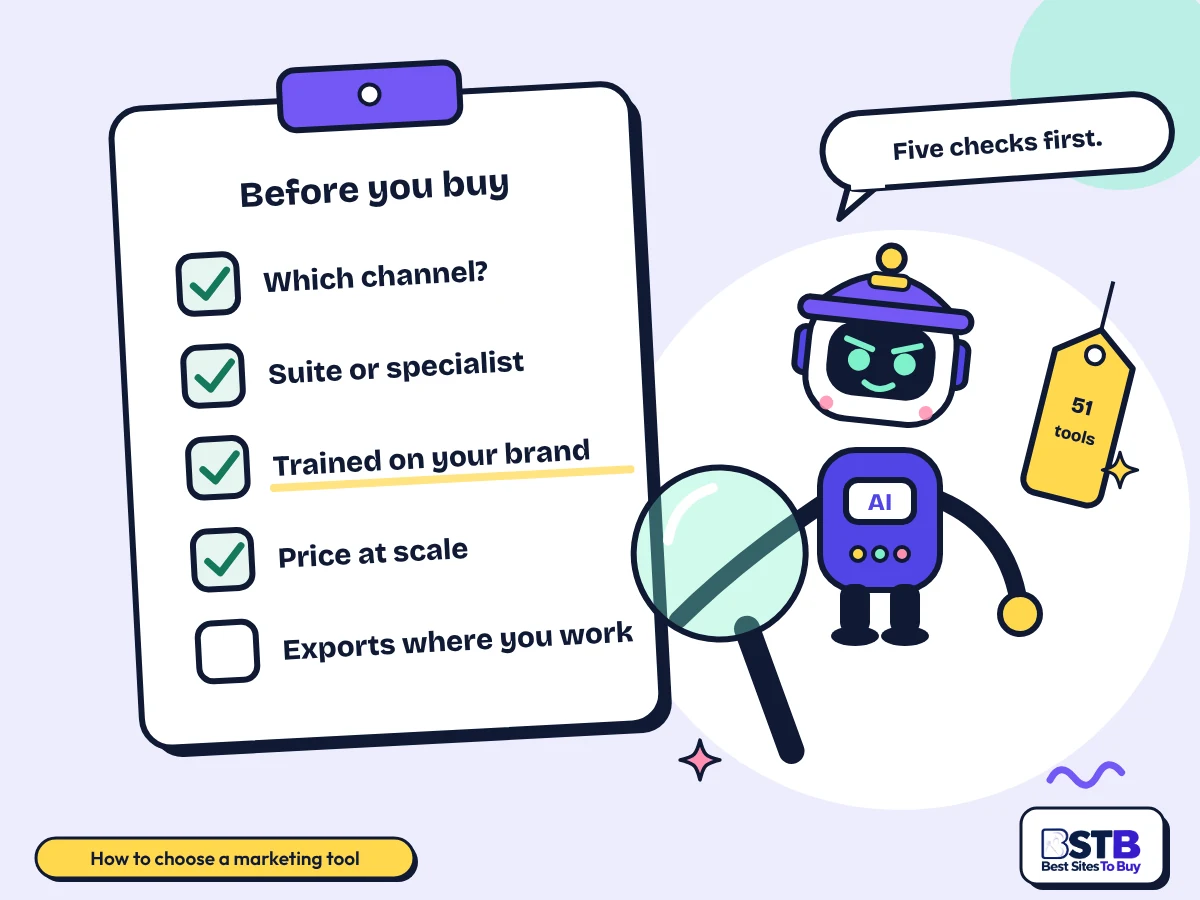
How to choose an AI marketing tool: a checklist reading which channel, suite or specialist, trained on your brand, price at scale and exports where you work
Naming the channel first removes eight ninths of the list.
Pricing

Free vs Paid AI Marketing Tools

19 of the 51 tools here have a free tier and 32 are paid or quote only. Entry plans run from about $5 a month to $1,250, and the enterprise analytics tools are priced in thousands.

Prices come from each tool's BSTB page. Two warnings specific to this category. First, the pricing shapes are incompatible: per seat, per channel, per contact and per credit cannot be compared without modelling your own numbers. Second, a majority of the tools checked here carry at least one unconfirmed, contradictory or sign-up-only price, and where that is the case the card says reported. Confirm on the vendor's own site before you buy.

Use with care

Limits, Brand Safety and the Law

Generated copy invents claims, synthetic media increasingly has to be disclosed, customer data pasted into prompts can breach your own privacy policy, and almost nothing here measures whether it made money.

  • Invented claims: AI writes confident specifics about pricing, results and credentials. Every factual claim needs checking before it ships.
  • Disclosure rules: advertising standards bodies and the major platforms increasingly expect AI-generated media to be labelled.
  • Customer data in prompts: pasting a customer list into a general tool may breach your own privacy policy, let alone GDPR.
  • Sameness at scale: the same tools produce the same structures, and a market where everyone uses them converges fast.
  • Search risk: Google targets scaled content abuse, meaning mass-produced pages made to rank rather than to help.
  • No proof it worked: channel metrics are abundant, revenue attribution is almost absent across this entire category.
Our method

How BSTB Rates AI Marketing Tools

BSTB scores every one of these marketing tools on the same nine criteria, and the overall score on each card is the plain average of the nine.

  • Accuracy and Reliability
  • Ease of Use
  • Functionality and Features
  • Performance and Speed
  • Customization and Flexibility
  • Data Privacy and Security
  • Support and Resources
  • Cost-Efficiency
  • Integration Capabilities

Scores are based on each tool's official pages, documentation, pricing and public user feedback. Read the full method on how BSTB tests and scores tools.

Related AI Tool Categories

Marketing tools overlap with these categories. Browse them when you need a narrower tool, or go back to the full AI tools directory.

FAQs

AI Marketing Tools: Frequently Asked Questions

PLACEHOLDER - rewritten once the client FAQ list arrives.

What Are AI Marketing Tools?

They are tools that generate, target or measure marketing work using AI: writing content, building creative, choosing audiences, scheduling sending and reporting results, organised by channel.

The word covers nine fairly different products. An SEO platform and an email sender are both AI marketing tools and they solve nothing in common, which is why naming your channel is the first step in choosing one.

  • Nine channels: SEO, social, content, email, video, ads, design, automation, analytics.
  • What the AI adds: volume, variation and speed, rather than judgement.
  • What it does not do: decide positioning, pricing or whether the campaign was wise.
  • Not substitutes: an SEO tool does not replace an email tool, however similar the marketing sounds.

If a tool claims to do all nine well, check which of the nine it actually leads on.

How Do I Choose the Right AI Marketing Tool for My Business?

Name the channel you are trying to fix, decide whether you need a suite or a specialist, then test the shortlist on your own brand and model the price at the size you expect to be in a year.

The most common mistake is buying a suite when one channel is the actual problem, or buying four specialists when you are one person. Size and channel between them answer the question most of the time.

  • One marketer, five channels: a suite. HubSpot, Blaze or Simplified.
  • One strategic channel: a specialist. Clearscope for SEO, Pencil for ads.
  • Ecommerce specifically: Lebesgue, Proxima, SellerPic and Zepic are built for it.
  • Model the price: per seat, per contact, per channel and per credit all scale differently.

Use the Marketing channel filter above the grid. It eliminates eight ninths of the list in one click.

How Is AI Used in Marketing?

Mostly for production: writing copy, generating creative variants, resizing per channel and scheduling. Targeting and measurement are the second tier, and strategy remains human.

Across the 51 tools here the pattern is consistent. AI handles the repetitive production work that scales badly with a small team, and leaves the decisions about positioning, offer and budget where they were.

  • Production: copy, creative, video, resizing and scheduling. The bulk of the category.
  • Targeting: audience building, segmentation and lookalikes from your own data.
  • Measurement: joining spend to sales, which only three tools here genuinely do.
  • Not automated: positioning, offer, pricing and whether to run the campaign at all.

If your marketing problem is strategic, no tool on this page is the answer.

Why Use AI Marketing Tools, and What Are the Benefits?

Volume, variation and consistency. A small team can publish more, test more creative variants and keep to a schedule in a way that previously needed several more people.

The benefit that holds up best is testing. Generating twenty ad variants and scoring them before spending is genuinely new, and it changes the economics of paid acquisition more than faster copywriting does.

  • More variants, tested: the clearest win, and it is measurable against your own spend.
  • Consistency: a schedule that survives a busy week, which compounds over months.
  • Fewer handoffs: one person can now cover channels that used to need three.
  • Faster first drafts: real, but the smallest of the four benefits in practice.

Measure against a baseline you captured before you started. Otherwise you are guessing.

Which AI Marketing Tools Are Best for a Small Business or Solo Marketer?

A free or cheap suite plus one specialist. HubSpot has a genuine free tier, Buffer costs $5 per channel and Robopost AI starts at $9 a month.

Small teams lose money on enterprise suites they use a tenth of. The tools priced per channel or per contact scale down gracefully, and the ones priced per seat with a minimum do not.

  • Free to start: HubSpot, Make, Stripo, Buffer and Robopost AI all have real free tiers.
  • Cheapest email: Hostinger Reach, from under $2 a month on a long term.
  • Cheapest social: Buffer at $5 per channel, or Robopost at $9 flat.
  • Avoid early: Blueshift from $1,250 a month and Dema.ai from EUR 2,250.

Count the channels you genuinely post to. Paying per channel is cheap until it is not.

How Do AI Marketing Tools Work Under the Hood?

Most call a general language or image model and wrap it in channel-specific context: your brand voice, your past content, the ranking pages, the platform's format rules and your performance data.

The model is rarely the differentiator because most tools use the same few. What separates them is the context they feed it and the data they have about what performs, which is why tools connected to your own history outperform generic ones.

  • Shared models: most call the same handful of third-party models underneath.
  • Context is the product: brand voice, past content, SERP data, performance history.
  • Performance data: tools with scoring are trained on outcome data, not just text.
  • Ask which model: relevant if you have data residency or confidentiality obligations.

Two tools using the same model can differ enormously, and the difference is the context they build.

Are Free AI Marketing Tools Worth Using?

Yes, for a genuine subset. 19 of the 51 tools here have a free tier, and several of them are usable indefinitely rather than being disguised trials.

Free tiers in this category are usually capped by volume rather than time: contacts, channels, credits or generations. That makes them genuinely workable for a small operation and useless at scale, which is the honest trade.

  • Genuinely free: HubSpot's CRM, Make's automation, Stripo's editor, Buffer's scheduler.
  • Capped by volume: contacts, channels or credits rather than a countdown.
  • Where free breaks: once you need multiple seats or multi-brand support.
  • Watch for: free tiers that reserve broader rights over your content than paid ones.

A free tier is a real option below a certain size. Model where that line is for you.

Are AI Marketing Tools Replacing Marketers?

They are replacing marketing tasks, not marketers. Production work compresses sharply; deciding what to say, to whom and why does not, and neither does being accountable for the result.

The visible change is in team shape rather than team size. The repetitive production roles compress, and the work that grows is editing, judgement and knowing when the output is wrong, which requires more experience rather than less.

  • Compressing: first drafts, resizing, variant production, scheduling.
  • Growing: editing, brand judgement, measurement and spotting the confident error.
  • Not touched: positioning, pricing, partnerships and customer understanding.
  • Accountability: nobody has yet found a tool that takes responsibility for a bad campaign.

The skill that rose in value is knowing when the output is wrong, which only comes from experience.

What Does a Complete AI Marketing Stack Cost Per Month?

A workable small-business stack runs about $50 to $150 a month. A mid-market stack with best-in-class tools per channel is realistically $400 to $900. No competitor page answers this question at all.

Every comparison page prices tools individually, which hides the real number. Four subscriptions at $79 is $316 a month, and that is before the automation layer that joins them or the seats you add as the team grows.

  • Lean stack: about $50 to $150: a free CRM, a cheap scheduler, an email tool, automation.
  • Mid-market: about $400 to $900 across SEO, social, email, ads and analytics.
  • Enterprise analytics: a single tool here starts at EUR 2,250 a month.
  • The hidden line: the automation layer, needed once you pass three tools.

Add up your whole stack annually. The number is usually larger than anyone in the team expects.

Is AI Generated Marketing Content a Risk Under GDPR or Advertising Rules?

It can be, in three ways none of the competitor pages mention: customer data pasted into prompts, undisclosed synthetic media, and generated claims you cannot substantiate.

The legal exposure is rarely the AI itself. It is the ordinary marketing rules applied to content produced faster than anyone can check it. A fabricated statistic in an ad is a problem whoever typed it.

  • Customer data in prompts: may breach your own privacy policy as well as GDPR.
  • Synthetic media: increasingly must be labelled, and rules differ per platform and country.
  • Unsubstantiated claims: advertising standards apply identically to AI-written copy.
  • Keep a review step: one human approval before anything public is the whole control.

Speed is the risk. The faster the production, the more important the approval step becomes.

Will AI Generated Content Hurt My Search Rankings?

Not for being AI-written. Google's guidance targets scaled content abuse, meaning mass-produced pages made primarily to rank rather than to help, however they were produced.

Two of the five competitor pages answer the soft version of this question and none addresses the actual policy. The distinction that matters is between using AI to produce useful pages and using it to produce volume.

  • Fine: AI-assisted pages, edited, with real information and a reason to exist.
  • Not fine: hundreds of near-identical pages differing only by keyword or location.
  • Answer engines too: AEO tools here track whether assistants cite you, a separate job.
  • Edit the output: unedited generated text is near-duplicate across everyone using the same tool.

The question is whether the page helps someone, not which tool produced it.

How Do I Measure Whether an AI Marketing Tool Paid for Itself?

Capture a baseline before you start, then compare the same metric over the same period length. Almost no tool reports this for you, which is the largest measurement gap in the category.

Every page in this SERP sells the analytics features of tools. None explains how to measure whether the tool itself earned its subscription. The method is unglamorous and it works: baseline, single change, same window.

  • Capture a baseline: traffic, open rate, cost per acquisition, before anything changes.
  • Change one thing: adding three tools at once tells you nothing about any of them.
  • Same window: compare like periods, and account for seasonality.
  • Count the time: hours saved are real value, and are usually the honest win.

If you cannot name the metric a tool should move, you are not ready to buy it.

Which AI Marketing Tools Suit Ecommerce Versus B2B?

They are genuinely different shortlists, and no competitor page splits them. Ecommerce needs product imagery, paid social and profit analytics. B2B needs search visibility, long-form content and CRM-attached email.

Nobody segments by business model, which is why generic best-of lists disappoint. A tool built on Shopify signals is useless to a B2B SaaS company, and an answer-engine visibility tracker is close to irrelevant for a local shop.

  • Ecommerce: Lebesgue, Proxima, SellerPic, ProductAI, Zepic, Blend AI, Dema.ai.
  • B2B SaaS: Clearscope, Frase, Writesonic, Tely AI, Copy.ai, HubSpot.
  • Local services: PosterMyWall, Robopost AI, Hostinger Reach, Buffer.
  • Agencies: Akkio, Flick, Aidelly-style multi-brand pricing and Semrush One.

Ask whether a tool's data sources match your business. Shopify signals mean nothing to a B2B pipeline.

How Does BSTB Score AI Marketing Tools?

BSTB scores every marketing tool on nine criteria: accuracy and reliability, ease of use, functionality, performance, customisation, data privacy, support, cost-efficiency and integrations.

The score on each card is the plain average of those nine. This category holds 218 listed tools, of which 75 were shortlisted across all nine channels and checked individually; 51 are on this page.

  • Nine criteria: each scored separately, then averaged.
  • 218 listed, 75 checked: the shortlist method is stated rather than hidden.
  • Cut at 3.9: the page ends at a score boundary, not mid-tier.
  • Full method: see how BSTB tests and scores tools.

Card ratings on the category listing all show 0.0 and are not used for ranking anywhere.

How Often Is This List of AI Marketing Tools Updated?

BSTB rechecks this list whenever a tool changes its pricing, plans or availability, and reviews the whole category on a rolling basis as new tools are listed.

This is the largest and fastest-moving category on the site. Several tools here are mid-acquisition, several have been renamed, and a majority carry at least one price that could not be confirmed against the vendor. Each tool's own BSTB page carries the last checked figures.

  • Rolling review: rechecked as tools launch, change price or disappear.
  • Status flags: shown on the card when a tool is renamed, in beta or changing hands.
  • Per-tool pages: the detail lives on each tool's own review page.
  • Spotted a change: tell us through the contact page.

Where a price is marked reported, confirm it with the vendor before budgeting against it.

Psst! Built an AI marketing tool?

Get Your AI Marketing Tool Listed on BSTB

Send us your tool's name, website and pricing. The BSTB team reviews every submission before it joins the AI tools directory.

List your AI marketing tool on BSTB: a rocket labelled BSTB-1 carrying Scout towards a directory card with a freemium badge and a nine point score
On this page