
Quick answer: An abbreviation is a shortened form of a word or phrase, such as “Dr.” for doctor or “ASAP” for as soon as possible. This list covers 400+ common abbreviations and their meanings, from text and social media abbreviations to business, academic and everyday English abbreviations.
Abbreviations are everywhere: in texts, emails, social media captions, school papers and street signs. This list of abbreviations groups the most common short forms by where you will see them, so you can find a meaning fast, then use the explainer sections at the end to learn how to abbreviate correctly.
Most abbreviations follow one of four simple patterns. Acronyms like NASA are said as words, initialisms like FBI are read letter by letter, clipped words like “info” drop the ending, and contractions like “Dr.” keep the first and last letters. Once you recognize the pattern, guessing the meaning of a new short form becomes much easier.
This BestSitesToBuy guide is built for students, professionals, writers and social media users. Each list groups abbreviations by where you meet them, from texts and captions to emails, offices and classrooms, so you can scan the right table, find the meaning in seconds and use it correctly.
Most Common Abbreviations in English
The most common abbreviations in English are short forms people read every day without thinking, such as Mr., Dr., Inc. and approx. They appear on letters, forms, addresses and labels. Knowing these everyday English abbreviations helps you read faster and write more clearly in both casual and formal settings.
Most English abbreviations keep the first letters of a word and end with a period in American English. British English often drops the period when the abbreviation ends with the word’s last letter, as in “Dr” or “Mr”. Below is a list of common abbreviations with their full meanings.
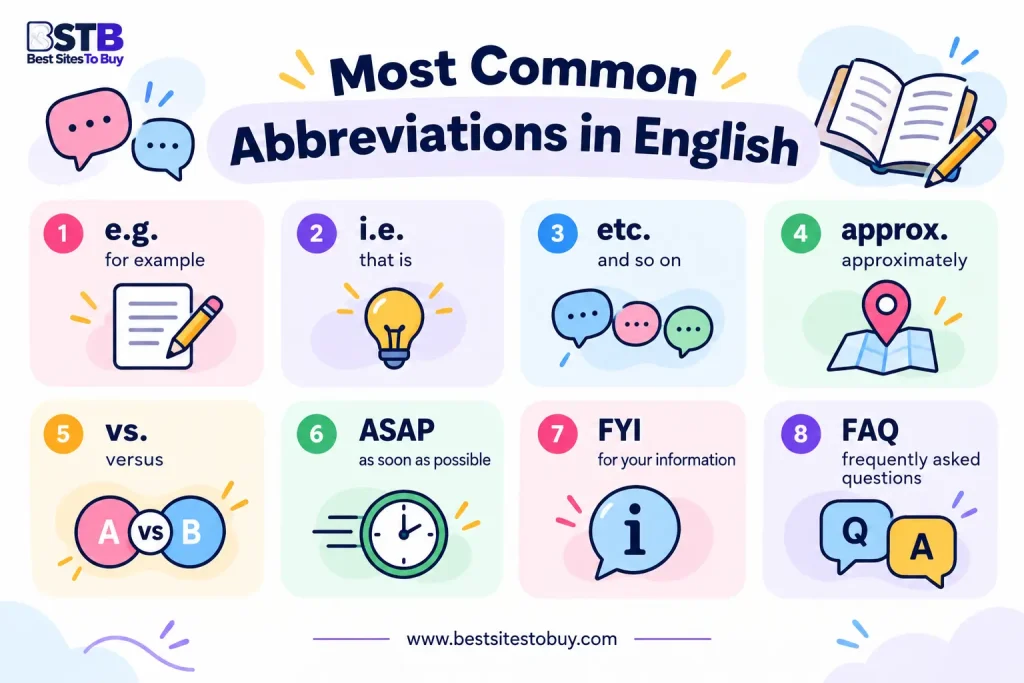
- Titles: Mr., Mrs., Dr. and Prof.
- Everyday words: approx., dept. and info.
- Latin terms: e.g., i.e. and etc.
- Mr.: Mister
- Mrs.: Missus (a married woman)
- Ms.: A woman, regardless of marital status
- Dr.: Doctor
- Prof.: Professor
- Jr.: Junior
- Sr.: Senior
- St.: Street or Saint
- Ave.: Avenue
- Blvd.: Boulevard
- Rd.: Road
- Apt.: Apartment
- Mt.: Mount or Mountain
- Co.: Company or County
- Inc.: Incorporated
- Ltd.: Limited
- Corp.: Corporation
- Bros.: Brothers
- Est.: Established
- Approx.: Approximately
- Misc.: Miscellaneous
- Min.: Minimum or minute
- Max.: Maximum
- Avg.: Average
- Info: Information
- Temp.: Temperature or temporary
- Tel.: Telephone
- Govt.: Government
- Dept.: Department
- Assoc.: Association or associate
- Lb.: Pound (weight)
- Oz.: Ounce
- Ft.: Foot or feet
- In.: Inch
- Yd.: Yard
- Mi.: Mile
- Gal.: Gallon
- Tsp.: Teaspoon
- Tbsp.: Tablespoon
- Hwy.: Highway
Everyday Abbreviations You See Daily
Everyday abbreviations like ASAP, RSVP and FYI show up on invitations, signs and messages. These short forms save time in daily life, and most English speakers recognize them instantly.
- ASAP: As soon as possible
- RSVP: Répondez s’il vous plaît (please reply)
- ETA: Estimated time of arrival
- DIY: Do it yourself
- AKA: Also known as
- FYI: For your information
- TBA: To be announced
- TBC: To be confirmed
- TBD: To be determined
- N/A: Not applicable or not available
- DOB: Date of birth
- AM: Ante meridiem (before noon)
- PM: Post meridiem (after noon)
- PS: Postscript
- ID: Identification
- ATM: Automated teller machine
- PIN: Personal identification number
- FAQ: Frequently asked questions
- VIP: Very important person
- BYOB: Bring your own bottle
Latin Abbreviations Used in English
Latin abbreviations such as e.g., i.e. and etc. are common in writing. They come from Latin phrases, so knowing the original meaning helps you use each abbreviation correctly in sentences.
- e.g.: Exempli gratia (for example)
- i.e.: Id est (that is)
- etc.: Et cetera (and so on)
- et al.: Et alii (and others)
- vs.: Versus (against)
- cf.: Confer (compare)
- N.B.: Nota bene (note well)
- ca.: Circa (around or approximately)
- viz.: Videlicet (namely)
- ibid.: Ibidem (in the same place)
- Q.E.D.: Quod erat demonstrandum (which was to be shown)
- A.D.: Anno Domini (in the year of the Lord)
Text Abbreviations and Their Meanings
Text abbreviations are short forms people use in text messages and chats to type faster, like LOL, BRB and IDK. Texting abbreviations started with SMS character limits and stayed popular because they feel casual and quick. Today, text message short forms appear in every messaging app.
Knowing common texting abbreviations helps you understand friends, family and even brands that text customers. The lists below cover the most common text abbreviations, popular text slang words and the text symbols people use to show tone, so you never miss the meaning in a text message again.
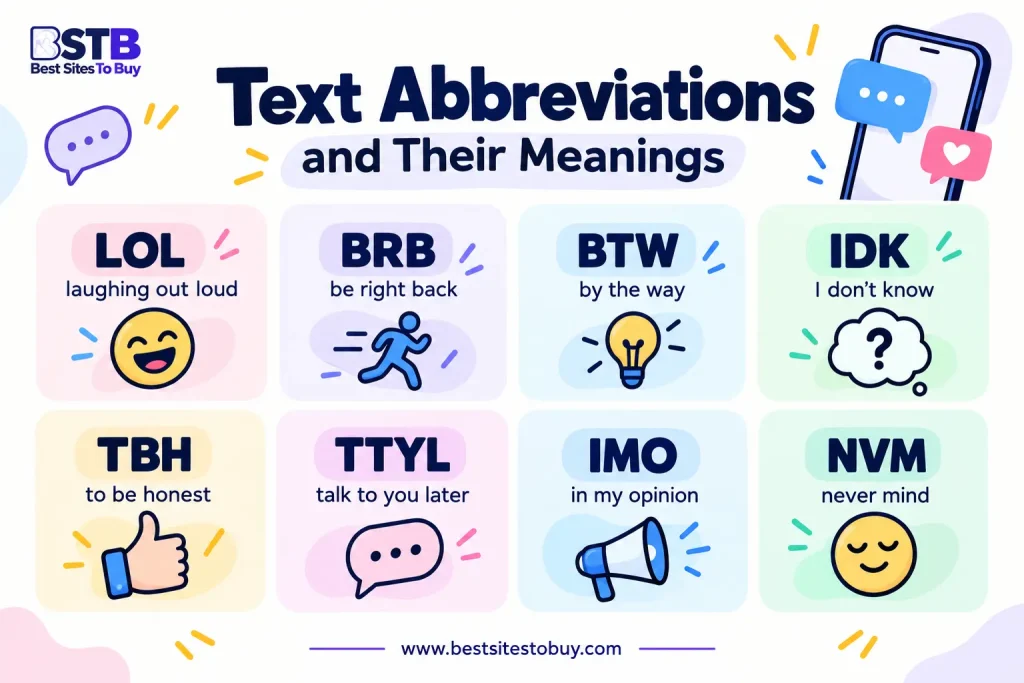
- Speed: short forms keep chats quick.
- Tone: LOL and TBH add friendliness.
- Context: meanings can change by group or age.
Most Common Texting Abbreviations
The most common texting abbreviations and text acronyms, like LOL, OMG and TTYL, appear in almost every chat. This text abbreviations list covers the short forms seen most.
- LOL: Laughing out loud
- OMG: Oh my god (or oh my gosh)
- BRB: Be right back
- BTW: By the way
- IDK: I don’t know
- IMO: In my opinion
- IMHO: In my humble opinion
- TBH: To be honest
- SMH: Shaking my head
- TTYL: Talk to you later
- LMK: Let me know
- NVM: Never mind
- IRL: In real life
- FWIW: For what it’s worth
- BFF: Best friends forever
- GTG: Got to go
- JK: Just kidding
- NP: No problem
- TY: Thank you
- THX: Thanks
- YW: You’re welcome
- OMW: On my way
- HBU: How about you?
- WYD: What are you doing?
- ILY: I love you
- IKR: I know, right?
- AFAIK: As far as I know
- TL;DR: Too long; didn’t read
- ROFL: Rolling on the floor laughing
- FOMO: Fear of missing out
- YOLO: You only live once
- NGL: Not gonna lie
- RN: Right now
- TBF: To be fair
- IDC: I don’t care
- BC: Because
- B4: Before
- CU: See you
- CYA: See ya
- GR8: Great
- L8R: Later
- ABT: About
- PLZ: Please
- PPL: People
- MSG: Message
- TXT: Text
- HMU: Hit me up
- IIRC: If I remember correctly
- WBU: What about you?
- OFC: Of course
Text Slang Words and Abbreviations
Text slang words like “bet,” “lowkey” and “no cap” mix with abbreviations in casual chats. These slang meanings change quickly, so this list focuses on terms widely used in 2026.
- Bet: Okay or agreed
- No cap: No lie, for real
- Slay: To do something really well
- Lowkey: Quietly or a little bit
- Highkey: Openly or very much
- Sus: Suspicious
- Mid: Average or unimpressive
- Rizz: Charm or flirting skill
- Bussin: Really good, usually food
- Salty: Bitter or upset
- Ghosting: Suddenly stopping all replies
- Vibe: A mood or feeling
- FR: For real
- ONG: On god (I swear)
- IYKYK: If you know, you know
- Ate: Did something perfectly
- Delulu: Delusional, often playfully
- Stan: A very devoted fan
- Tea: Gossip
- Shook: Shocked or surprised
- Extra: Over the top
- GOAT: Greatest of all time
- Fam: Close friends or family
- W / L: Win or loss
- Bae: Before anyone else, a partner
Text Symbols and What They Mean
Text symbols and emoticons add tone that words alone cannot show. Knowing what text symbols mean helps you read emotion in a message, from a playful wink to quiet annoyance.
- :): Smile or happy
- :(: Sad
- ;): Wink or joking
- :D: Big grin
- :P: Sticking out tongue, playful
- <3: Heart or love
- </3: Broken heart
- XD: Laughing hard
- :O: Surprised
- **_**: Happy or content
- **-_-**: Annoyed or unimpressed
- :/: Unsure or skeptical
- xoxo: Hugs and kisses
- …: Trailing off or an awkward pause
- !!: Strong emphasis or excitement
- ??: Confusion
- *: Correcting a typo in the previous message
- **@**: Mentioning a person
- #: Hashtag or topic tag
- ~: Playful or teasing tone
Social Media and Internet Abbreviations
Social media and internet abbreviations help people post, comment and reply quickly on Instagram, TikTok, X and YouTube. Terms like DM, POV and OOTD are now part of everyday online language. Knowing these social media short forms makes captions, comments and trending posts much easier to follow.
Brands and creators also use internet abbreviations in hashtags and captions to save space and match platform culture. If you manage social accounts, these internet short forms help you sound natural. Below are the most common online abbreviations, from Snapchat abbreviations to creator and marketing terms.
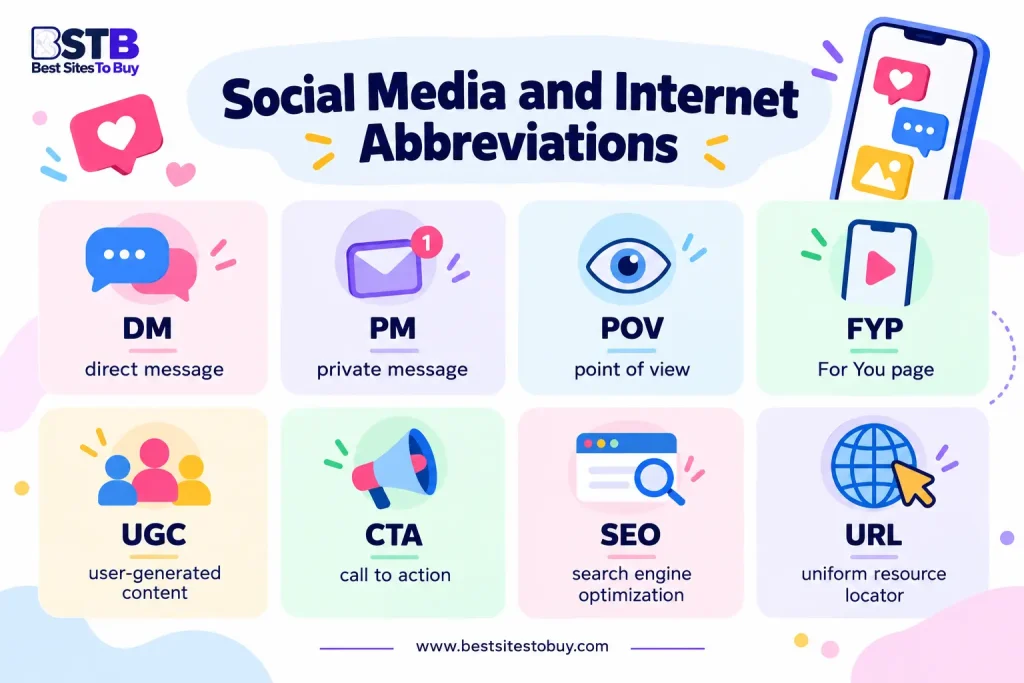
- Platforms: DM, IG and FYP appear daily.
- Engagement: tags like TBT and OOTD guide posts.
- Character limits: abbreviations save space.
- DM: Direct message
- RT: Retweet or repost
- QT: Quote tweet or quote post
- TBT: Throwback Thursday
- FBF: Flashback Friday
- OOTD: Outfit of the day
- GRWM: Get ready with me
- POV: Point of view
- TIL: Today I learned
- AMA: Ask me anything
- ELI5: Explain like I’m 5
- OP: Original poster
- NSFW: Not safe for work
- FTW: For the win
- MFW: My face when
- ICYMI: In case you missed it
- IG: Instagram
- FB: Facebook
- YT: YouTube
- FYP: For You page (TikTok)
- PFP: Profile picture
- OC: Original content
- UGC: User-generated content
- CTA: Call to action
- ER: Engagement rate
- F4F: Follow for follow
- L4L: Like for like
- AFK: Away from keyboard
- GG: Good game
- NPC: Non-player character, used for someone acting robotic
Business and Workplace Abbreviations
Business and workplace abbreviations make office communication faster in emails, meetings and reports. Terms like KPI, ROI and EOD are standard in most companies. Learning these office abbreviations helps new employees, freelancers and business owners follow conversations without stopping to ask what every acronym means.
Workplace acronyms vary by industry, but many are shared across marketing, finance and tech teams. Use them with colleagues who already know them, and spell them out for clients or new hires. The lists below cover general business abbreviations, email abbreviations and common job title abbreviations.
- Emails: FYI, EOD and ASAP.
- Roles: CEO, CFO and HR.
- Clarity: spell out rare terms for clients.
- KPI: Key performance indicator
- ROI: Return on investment
- B2B: Business to business
- B2C: Business to consumer
- EOD: End of day
- EOW: End of week
- COB: Close of business
- OOO: Out of office
- WFH: Work from home
- PTO: Paid time off
- SOP: Standard operating procedure
- SLA: Service level agreement
- NDA: Non-disclosure agreement
- P&L: Profit and loss
- QoQ: Quarter over quarter
- YoY: Year over year
- YTD: Year to date
- CRM: Customer relationship management
- SEO: Search engine optimization
- SaaS: Software as a service
- MVP: Minimum viable product
- R&D: Research and development
- PR: Public relations
- FTE: Full-time equivalent
- LLC: Limited liability company
Email Abbreviations
Email abbreviations like CC, BCC and FW keep professional messages short and clear. Use them in workplace emails, but spell out less common abbreviations when writing to new clients or partners.
- CC: Carbon copy
- BCC: Blind carbon copy
- FW / FWD: Forward
- RE: Regarding or reply
- NRN: No reply needed
- NNTR: No need to respond
- EOM: End of message
- PFA: Please find attached
- WRT: With regard to
- TIA: Thanks in advance
- BR: Best regards
- KR: Kind regards
- POC: Point of contact
- FYR: For your reference
- AOB: Any other business
Job Title Abbreviations
Job title abbreviations such as CEO, CFO and VP appear on business cards, LinkedIn profiles and email signatures. These professional short forms show a person’s role at a glance in workplace communication.
- CEO: Chief executive officer
- CFO: Chief financial officer
- COO: Chief operating officer
- CTO: Chief technology officer
- CMO: Chief marketing officer
- CIO: Chief information officer
- CHRO: Chief human resources officer
- VP: Vice president
- SVP: Senior vice president
- GM: General manager
- PM: Project manager or product manager
- HR: Human resources
- Mgr.: Manager
- Asst.: Assistant
- Dir.: Director
Abbreviations for Common Words
Abbreviations for common words are what many people search when they need the short form of a single word, like additional, paragraph or international. These word abbreviations are useful in forms, invoices, notes and documents where space is limited. Most follow simple, widely accepted patterns.
Many words have more than one accepted abbreviation, so choose the one your workplace or style guide prefers and use it consistently. The lists below group the most searched word abbreviations into writing, dates and time, places and business words, so you find the right short form fast.
- Writing: approx., misc. and vol.
- Dates and time: Jan., Mon. and a.m.
- Places: St., Ave. and US state codes.
Abbreviations for Writing and Documents
Abbreviations for writing and documents help with citations, notes and long reports. Short forms like para. for paragraph and ch. for chapter keep references clean and easy to scan.
- Additional: addl. or add’l
- Paragraph: para. or ¶
- Chapter: ch. or chap.
- Page: p. or pg.
- Pages: pp.
- Section: sec. or §
- Figure: fig.
- Volume: vol.
- Edition: ed.
- Number: no.
- Reference: ref.
- Appendix: app. or appx.
- Example: ex.
- Including: incl.
- Abbreviation: abbr. or abbrev.
- Translation: trans.
- Manuscript: MS
- Revised: rev.
- Introduction: intro.
- Footnote: fn.
- And: &
- With: w/
- Without: w/o
- Between: btwn.
- Each: ea.
- Something: sth. or smth.
Abbreviations for Dates and Time
Abbreviations for dates and time cover months, weekdays and common words like anniversary and tomorrow. These short forms are useful in calendars, schedules, invites and quick text messages.
- January: Jan.
- February: Feb.
- March: Mar.
- April: Apr.
- May: May (no abbreviation)
- June: Jun.
- July: Jul.
- August: Aug.
- September: Sept. or Sep.
- October: Oct.
- November: Nov.
- December: Dec.
- Monday: Mon.
- Tuesday: Tue. or Tues.
- Wednesday: Wed.
- Thursday: Thu. or Thurs.
- Friday: Fri.
- Saturday: Sat.
- Sunday: Sun.
- Anniversary: anniv.
- Tomorrow: tmrw or tmr (informal)
- Yesterday: yest. or yday (informal)
- Today: tdy (informal)
- Weekly: wkly.
- Monthly: mthly. or mo.
- Birthday: bday (informal)
- Hour: hr.
- Second: sec.
- Year: yr.
- Week: wk.
- Weekend: wknd (informal)
Abbreviations for Places and Organizations
Abbreviations for places and organizations include short forms like intl. for international and assn. for association. They appear in addresses, company names, official documents and event listings.
- International: intl. or int’l
- Association: assn. or assoc.
- Community: comm. or cmty.
- University: univ.
- Institute: inst.
- National: natl. or nat’l
- Organization: org.
- Committee: cmte.
- Society: soc.
- Foundation: fdn.
- District: dist.
- Building: bldg.
- Center: ctr.
- Square: sq.
- Headquarters: HQ
US State Abbreviations and Postal Codes
US state abbreviations are the official two-letter postal codes for the United States, used on mail and forms. All 50 state abbreviations use capital letters and no periods.
- AL: Alabama
- AK: Alaska
- AZ: Arizona
- AR: Arkansas
- CA: California
- CO: Colorado
- CT: Connecticut
- DE: Delaware
- FL: Florida
- GA: Georgia
- HI: Hawaii
- ID: Idaho
- IL: Illinois
- IN: Indiana
- IA: Iowa
- KS: Kansas
- KY: Kentucky
- LA: Louisiana
- ME: Maine
- MD: Maryland
- MA: Massachusetts
- MI: Michigan
- MN: Minnesota
- MS: Mississippi
- MO: Missouri
- MT: Montana
- NE: Nebraska
- NV: Nevada
- NH: New Hampshire
- NJ: New Jersey
- NM: New Mexico
- NY: New York
- NC: North Carolina
- ND: North Dakota
- OH: Ohio
- OK: Oklahoma
- OR: Oregon
- PA: Pennsylvania
- RI: Rhode Island
- SC: South Carolina
- SD: South Dakota
- TN: Tennessee
- TX: Texas
- UT: Utah
- VT: Vermont
- VA: Virginia
- WA: Washington
- WV: West Virginia
- WI: Wisconsin
- WY: Wyoming
Abbreviations for Business and Shipping Words
Abbreviations for business and shipping words appear on invoices, order forms and product labels. Short forms like rec’d for received and qty. for quantity keep records compact and readable.
- Received: rec’d or recd.
- Estimate: est.
- Development: dev.
- Recommendation: rec. or recs (informal)
- Replacement: repl.
- Accessories: acc. or accy.
- Communication: comm.
- Extension: ext.
- Industrial: ind.
- Attention: attn.
- Unknown: unk.
- Opportunity: opp. or oppty.
- Management: mgmt.
- Manufacturing: mfg.
- Account: acct.
- Customer: cust.
- Invoice: inv.
- Purchase order: PO
- Quantity: qty.
- Package: pkg.
Academic and APA Abbreviations
Academic and APA abbreviations appear in research papers, citations and reference lists. APA style, created by the American Psychological Association, sets clear rules for when to use abbreviations in academic writing. Students who learn these academic abbreviations write cleaner citations and avoid common formatting mistakes.
APA style asks writers to define an abbreviation the first time it appears, then use the short form after that. Reference abbreviations like ed., n.d. and p. are standard in citations. The lists below cover common APA abbreviations and the academic degree abbreviations you will see after names.
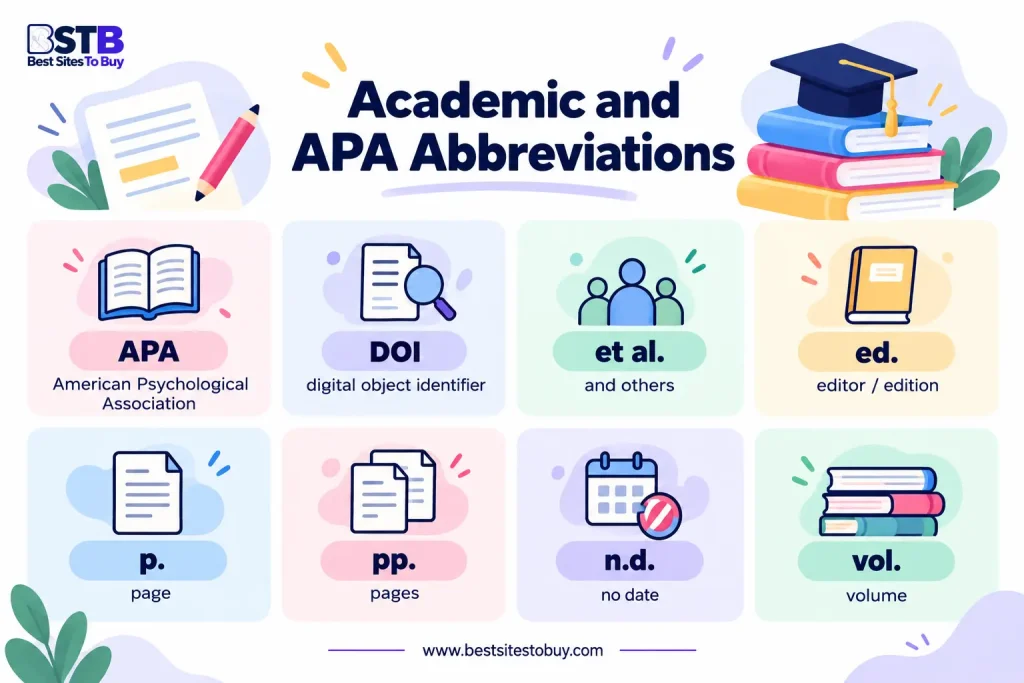
- Citations: et al., ed. and p.
- Degrees: BA, MS and PhD.
- Style guides: APA uses abbreviations sparingly.
- APA: American Psychological Association
- MLA: Modern Language Association
- DOI: Digital object identifier
- ISBN: International Standard Book Number
- ISSN: International Standard Serial Number
- n.d.: No date
- Ed. / Eds.: Editor or editors
- Trans.: Translator or translated by
- Rev. ed.: Revised edition
- Suppl.: Supplement
- para.: Paragraph (used in APA citations)
- GPA: Grade point average
- TA: Teaching assistant
- RA: Research assistant
- Ph.D. / PhD: Doctor of Philosophy
Academic Degree Abbreviations
Academic degree abbreviations show a person’s qualifications after their name. These short forms appear on resumes, business cards and academic papers, and they follow standard university naming.
- AA: Associate of Arts
- BA: Bachelor of Arts
- BS / BSc: Bachelor of Science
- MA: Master of Arts
- MS / MSc: Master of Science
- MBA: Master of Business Administration
- MFA: Master of Fine Arts
- MD: Doctor of Medicine
- JD: Juris Doctor
- EdD: Doctor of Education
- LLB: Bachelor of Laws
- LLM: Master of Laws
What Is an Abbreviation?
An abbreviation is a shortened form of a word or phrase that stands in for the full version, such as “Dr.” for doctor or “ASAP” for as soon as possible. The abbreviation meaning stays the same as the original word, only written in fewer letters to save time and space.
The word “abbreviation” comes from the Latin “brevis,” meaning short. When something is abbreviated, it has been cut down to a shorter form. Abbreviations include acronyms, initialisms, contractions and clipped words, and each type follows slightly different rules for spelling, capital letters and periods.
- Definition: a shortened form of a word or phrase.
- Same meaning: only the spelling gets shorter.
- Origin: from the Latin “brevis,” meaning short.
- Includes: acronyms, initialisms, contractions and clipped words.
What Are the Types of Abbreviations?
There are four main types of abbreviations: acronyms, initialisms, contractions and shortened words. Each type shortens language in a different way. Acronyms are spoken as words, initialisms are read letter by letter, and contractions or clipped words drop letters from the middle or end of a word.
Knowing the types of abbreviations helps you choose the correct spelling, capitalization and punctuation. It also explains why “NASA” sounds like a word while “FBI” does not. The sections below explain what an acronym is, what an initialism is and how shortened words and contractions work.
- Acronyms: said as words, like NASA.
- Initialisms: read letter by letter, like FBI.
- Contractions: keep first and last letters, like Dr.
- Clipped words: drop the ending, like info.
What Is an Acronym?
An acronym is an abbreviation formed from the first letters of words and pronounced as a single word, like NASA, SCUBA or FOMO. Acronyms are usually written in capital letters without periods.
- Pronounced: as one word.
- Examples: NASA, SCUBA and FOMO.
- Style: capital letters without periods.
What Is an Initialism?
An initialism is an abbreviation made from first letters but read one letter at a time, like FBI, CEO or DIY. Initialisms look like acronyms, but they are not pronounced as words.
- Pronounced: letter by letter.
- Examples: FBI, CEO and DIY.
- Style: capital letters, usually no periods.
What Are Shortened Words and Contraction Abbreviations?
Shortened words and contractions are abbreviations that cut part of a word, such as “info” for information or “Dr.” for doctor. Some drop letters from the middle, while others clip the ending.
- Clipped words: info, demo and photo.
- Contractions: Dr., Mr. and Ltd.
- Pattern: letters dropped from the middle or end.
Abbreviation vs Acronym vs Initialism: What Is the Difference?
The difference between an abbreviation, an acronym and an initialism is scope. Abbreviation is the umbrella term for any shortened word or phrase. An acronym is a type of abbreviation pronounced as a word, while an initialism is a type of abbreviation pronounced letter by letter, like FBI.
So every acronym is an abbreviation, but not every abbreviation is an acronym. People often use “acronym” for all short forms, which is technically wrong. The table below compares abbreviation vs acronym vs initialism side by side, with examples and pronunciation, so you can tell them apart instantly.
- Abbreviation: the umbrella term for any short form.
- Acronym: a short form spoken as a word.
- Initialism: a short form spoken letter by letter.
- Key rule: every acronym is an abbreviation, not the reverse.
| Type | How it is formed | How it is said | Examples |
|---|---|---|---|
| Abbreviation | Any shortened word or phrase | Varies | Dr., Mon., approx. |
| Acronym | First letters of words | As one word | NASA, FOMO, SCUBA |
| Initialism | First letters of words | Letter by letter | FBI, CEO, DIY |
| Contraction | Letters removed from the middle | Like the full word | Dept., govt., can’t |
Why Do We Use Abbreviations?
We use abbreviations because they save time, space and effort when writing or speaking. Short forms make long names, titles and phrases easier to read and remember. In text messages and social media posts, abbreviations also keep conversations quick, casual and within character limits that some platforms set.
Abbreviations also signal belonging. Shared text abbreviations, workplace acronyms and industry terms show that people speak the same language. However, the same shortened words can confuse readers outside that group. The best writers use abbreviations to make communication clearer, never to make it harder for their audience to follow.
- Save time: fewer letters to write and type.
- Save space: fit character limits and forms.
- Easier reading: long names become manageable.
- Belonging: shared short forms signal a group.
How Do Abbreviations Save Time in Writing?
Abbreviations save time in writing by replacing long words with short forms. Using “approx.” or “info” in notes and messages cuts typing time without losing the meaning for readers.
- Notes: quick shortcuts like “approx.”
- Messages: faster typing on phones.
- Documents: shorter repeated terms.
How Do Text Abbreviations Shape Online Communication?
Text abbreviations shape online communication by adding speed and tone. Short forms like LOL and TBH make chats feel friendly, which is why brands use them in social media replies.
- Speed: quick replies in chats.
- Tone: LOL and TBH sound friendly.
- Brands: use them in casual social replies.
How Do You Abbreviate a Word Correctly?
To abbreviate a word correctly, keep the first letter and enough of the word that readers still recognize it, such as “dept.” for department. Check whether an accepted abbreviation already exists, because inventing your own short form can confuse readers and make writing look careless.
Next, follow your style guide on periods and capital letters. American English usually adds a period after abbreviations like “approx.”, while acronyms like NASA skip periods. When you are unsure how to abbreviate a word, a dictionary or the abbreviation lists above will show the most common accepted form.
- Keep it recognizable: first letter plus key letters.
- Use accepted forms: check a dictionary first.
- Follow your style guide: periods and capitals vary.
- Stay consistent: use one form per document.
When Should You Use Periods and Capital Letters in Abbreviations?
Use periods in abbreviations that shorten a single word, like “Mr.” or “etc.”, in American English. Acronyms and initialisms usually use capital letters with no periods, such as NASA and FBI.
- Periods: single-word short forms, like Mr. or etc.
- No periods: acronyms and initialisms, like NASA.
- Capitals: used for most acronyms and initialisms.
How Do You Write Plural Abbreviations?
To write plural abbreviations, add a lowercase “s” without an apostrophe, such as “CEOs” or “DVDs.” Use an apostrophe only to avoid confusion with single letters, like “A’s.”
- Add “s”: CEOs, DVDs and FAQs.
- No apostrophe: in most cases.
- Exception: use an apostrophe for single letters, like A’s.
When Should You Spell Out an Acronym First?
Spell out an acronym the first time you use it, then add the abbreviation in parentheses. After that first mention, use the short form throughout the rest of your document.
- First mention: write the full term.
- Parentheses: add the short form after it.
- Afterward: use the abbreviation only.
When Should You Avoid Using Abbreviations?
You should avoid abbreviations when your reader might not know them, such as in formal writing, legal documents, customer emails and content for a general audience. If an abbreviation forces readers to stop and guess, it slows communication down instead of speeding it up.
Style guides recommend using abbreviations sparingly, especially in reports and publications. Avoid starting a sentence with an abbreviation, and do not use text abbreviations like “u” or “rn” in professional messages. When in doubt, write the full word. Clear writing always matters more than saving a few letters.
- Formal writing: legal, academic and official documents.
- Unknown readers: customers and general audiences.
- Sentence starts: avoid opening with an abbreviation.
- Text slang: skip “u” or “rn” at work.
Can AI Tools Help You Understand Abbreviations?
Yes, AI tools can help you understand abbreviations quickly. Assistants like ChatGPT can explain what an abbreviation means in context, which is useful when the same short form has several meanings. You can paste a confusing text message or email and ask what each abbreviation stands for.
AI tools are also helpful when writing captions, emails and posts for social media. They can suggest whether an abbreviation fits your audience or should be spelled out. Always double-check industry-specific acronyms, though, because AI tools can guess wrong when an abbreviation is rare or new.
- Context: AI explains meanings in your message.
- Multiple meanings: it can pick the right one.
- Writing help: it suggests when to spell out.
- Double-check: rare or industry terms can trip AI up.
What Are the Best AI Tools for Decoding Abbreviations?
The best AI tools for decoding abbreviations include ChatGPT for quick explanations in context. Compare more AI tools, scores and pricing in our hands-on AI tools reviews before choosing one.
- ChatGPT: explains short forms in context.
- Compare: see scores and pricing in our AI tools reviews.
- Tip: paste the full message for better answers.
Final Thoughts on Common Abbreviations
Common abbreviations make reading and writing faster once you know what they mean. With 400+ abbreviations sorted by text, social media, business, academic and everyday use, this list gives you a quick reference for any short form you meet in messages, emails, captions or documents.
Use abbreviations when your audience knows them, and spell them out when they might not. If you create content for social media, explore BestSitesToBuy for guides on the social media tools our team has tested and the latest reviews on the BestSitesToBuy blog.