Best AI Copywriting Tools 2026: Free AI Copywriters - BSTB

Psst! 25 copy tools inside

25 Best AI Copywriting Tools in 2026 for Ads, Product Descriptions, Landing Pages and Email

AI copywriting tools write the copy that sells: ad headlines, product descriptions, landing page sections, email sequences and the fifty variants you need to test any of it properly. This page ranks the 25 best AI copywriting tools on BSTB by their 9-criterion score, each with its pricing model, the kind of copy it writes and a plain-English summary.

Top 25 of 41 tools 9 of 25 free to start
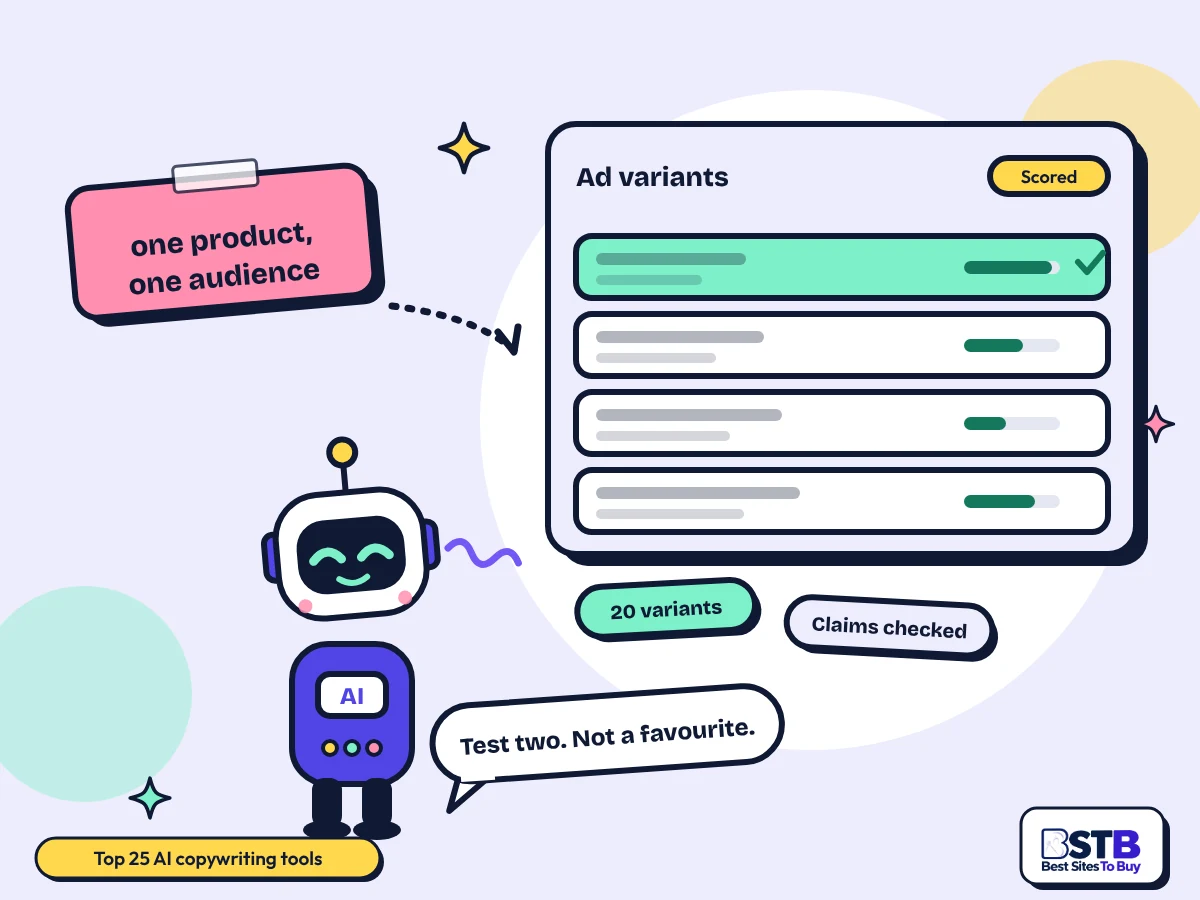
Best AI copywriting tools: Scout the BSTB robot beside a pink brief card reading one product one audience and a scored list of four ad variants with the winner ticked

Why You Can Trust BSTB's AI Tool Listings

Every AI copywriting tool on this page has its own BSTB page with a pricing model, plan prices, the kind of copy it writes and a score from the same nine criteria.

  • One scoring method for every tool
  • Prices taken from each tool's official pages
  • Plain summaries of what the tool actually does

See how BSTB tests and scores AI tools.

The directory

Top 25 AI Copywriting Tools, Ranked by BSTB Score

Anyword, Copy.ai, Frase, Hypotenuse and Voila lead at 4.1/5; filter by price or by the kind of copy you need written.

Show:

Showing 25 of 25. Picked from the 41 tools listed in the BSTB Copywriting category, ranked by overall score.

Anyword

4.1/5Paid

Scores every version of a piece of copy against predicted performance before you publish, which is the closest thing here to testing without spending.

  • Best for: Choosing between variants on data
  • Price: Starter $49/mo ($39 yearly); Data-Driven $99/mo ($79 yearly); Business and Enterprise custom
Read the Anyword review

Buffer

4.1/5Freemium

Social scheduling dashboard with an AI assistant bolted on for post copy, so the writing and the publishing sit together.

  • Best for: Social copy written where it posts
  • Price: Free $0; Essentials $5 per channel/mo ($60/channel/yr); Team $10 per channel/mo
Read the Buffer review
Becoming Fullcast Propel

Copy.ai

4.1/5Paid

Began as a copy generator and is now a go-to-market workflow platform, with sales and marketing email among its strongest outputs.

  • Best for: Repeatable sales and marketing sequences
  • Price: Chat $29/mo ($24 annual); Growth $1,000/mo; Expansion $2,000/mo
  • Status: Becoming Fullcast Propel (see review)
Read the Copy.ai review

Frase

4.1/5Paid

SERP research, an AI writing agent and content scoring in one place, aimed at copy that has to rank as well as read.

  • Best for: Copy that has to rank
  • Price: 7-day free trial; Starter $39/mo yearly ($49 monthly); Professional $103/mo yearly; Scale higher
Read the Frase review

Hypotenuse

4.1/5Paid

Writes and enriches product descriptions across an entire catalogue rather than one at a time, which is the job most copy tools cannot do.

  • Best for: Whole catalogues, not single products
  • Price: Basic, Ecommerce Pro and Ecommerce Enterprise all custom quote
Read the Hypotenuse review

Voila

4.1/5Freemium

Browser extension that writes, rewrites, summarises and translates on whatever page you are already on, rather than in a separate app.

  • Best for: Writing without leaving the page
  • Price: Free $0; Premium $8/mo (one directory lists $10, contradictory)
Read the Voila review
Ownership moving to Constant Contact

Moosend

4.0/5Paid

Email marketing platform with an AI subject-line and body writer, so the copy is written inside the tool that sends it.

  • Best for: Email copy inside the sender
  • Price: 30-day free trial; Pro from $9/mo at 500 contacts (reported); Moosend+ and Enterprise custom
  • Status: Ownership moving to Constant Contact (see review)
Read the Moosend review

Pencil

4.0/5Paid

Generates, scores and launches ad creative with copy drawn from several models, covering the whole path from brief to live campaign.

  • Best for: Ad copy tied to the creative
  • Price: Free trial; Core $14/mo ($11 annual); Growth $55/mo ($44 annual); Pro custom
Read the Pencil review

GravityWrite

3.9/5Paid

One credit pool covering SEO posts, social copy, images, video and sites, which suits people writing across several formats.

  • Best for: Several formats on one credit pool
  • Price: Free reported but not on the official pricing page; Plus $8/mo billed yearly; higher tiers above
Read the GravityWrite review

Jasper

3.9/5Paid

Marketing content platform built around a trained brand voice, with more than a hundred marketing agents attached.

  • Best for: Brand voice across a marketing team
  • Price: Pro $59/seat/mo annual ($69 monthly); Business custom quote
Read the Jasper review

Rytr

3.9/5Freemium

Cheap template-driven writer covering emails, product copy, captions and SEO text, and the lowest credible entry price here.

  • Best for: The cheapest usable option
  • Price: Free $0; Unlimited $7.50/mo as displayed; Premium higher
Read the Rytr review

Scalenut

3.9/5Paid

Keyword research plus article drafting aimed at both Google and AI answer engines, with heavy annual discounts.

  • Best for: Search-led copy at a discount
  • Price: Starter $59/mo ($24 yearly); Plus $89/mo ($36 yearly); Professional $199/mo ($80 yearly)
Read the Scalenut review
Domain redirects to brandblast.com

Brandblast.ai

3.7/5Paid

Learns a brand from its own website, then produces posts, carousels and ad creative that match it without a separate setup.

  • Best for: Brand learned from your site
  • Price: Starter $39/mo ($470/yr); Growth $123/mo ($1,470/yr); higher tiers above
  • Status: Domain redirects to brandblast.com (see review)
Read the Brandblast.ai review

Eskritor

3.7/5Paid

Drafts, rewrites and summarises from more than 20 templates, a straightforward general writer rather than a specialist.

  • Best for: Straightforward general drafting
  • Price: Free trial $0; a permanent free tier is claimed by a tracker but not shown officially (unconfirmed)
Read the Eskritor review
Availability unclear

CreativAI

3.5/5Freemium

Asks a few questions and then writes blog, ad, email and site copy from the answers, aimed at people who dislike prompting.

  • Best for: People who would rather answer questions
  • Price: Free $0/mo; Premium $8.95/mo; lifetime option listed
  • Status: Availability unclear (see review)
Read the CreativAI review
Private beta, registration paused

Magic Type AI

3.3/5Freemium

Builds ecommerce product cards combining AI copy, images and layout, so the description arrives already designed.

  • Best for: Product cards, copy and layout together
  • Price: Free $0/mo, not purchasable by new users today; Pro $49/mo
  • Status: Private beta, registration paused (see review)
Read the Magic Type AI review
Availability unclear

SEOWriteX

3.2/5Paid

Template writer covering SEO posts, product copy, ads, emails and social, priced in euros rather than dollars.

  • Best for: Euro-priced template writing
  • Price: Discovery EUR 19/mo or EUR 193/yr; higher tiers above
  • Status: Availability unclear (see review)
Read the SEOWriteX review
The basics

What Are AI Copywriting Tools?

AI copywriting tools, sometimes sold as an AI copy generator, produce marketing copy from a short brief: an ad, a product description, an email or a landing section. Most are AI copywriting tools online, running in a browser. The good ones also score the output rather than just producing it.

They divide by the kind of copy. Ad tools such as Anyword and Pencil generate and score variants. Product tools such as Hypotenuse and Obsess AI write descriptions across a whole catalogue. Brand platforms such as Jasper and Typeface hold a trained voice for a team. The rest are all-round template writers that cover several formats adequately and none of them brilliantly.

What they are genuinely good at is volume and variation: twenty headlines instead of three, a catalogue of descriptions instead of a week of writing. What they cannot do is know your customer, and the copy that works usually comes from knowing something about the reader that the model does not.

How Do AI Copywriting Tools Work?

You give the tool a product, an audience and a format. It generates variants in that format, the stronger tools score them against past performance data, and you edit and test what comes back.

  1. You describe product and audience

    Not just the product. Who it is for and what they are worried about is what separates usable copy from a feature list in sentences.

  2. It generates in a format

    An ad, a subject line, a description, a landing section. Format matters because the constraints differ completely between them.

  3. Some score the variants

    A minority predict performance from past campaign data. This is the single most useful feature in the category and most tools do not have it.

  4. You edit and test

    Generated copy is a starting set. The ones that win are usually edited, and you only know which won by running them.

What Can You Do With an AI Copywriting Tool?

Write ad copy and headlines at volume, generate product descriptions across a catalogue, draft landing sections, write email sequences, adapt one message per audience and keep a team writing in one voice.

  • Generate ad variants: twenty headlines to test rather than the three you would have written.
  • Describe a whole catalogue: the job that genuinely does not scale with people.
  • Draft landing sections: hero, benefits, objections and call to action as a first pass.
  • Write email sequences: the fourth and fifth emails nobody gets round to writing.
  • Adapt per audience: one message rewritten for three segments in minutes.
  • Hold one brand voice: across a team, which is the case for AI copywriting tools for business.
By kind of copy

Best AI Copywriting Tools by Kind of Copy

The best AI copy generator for you depends on what you are writing. An ad tool and a product-description tool are not substitutes, and buying the wrong one is the most common mistake in this category.

All-round copy assistants

All-round template writers covering several copy formats. Cheapest way in, and weaker than a specialist on any single format.

Blog and long-form marketing copy

Blog and long-form marketing copy, usually with search research attached, for content that has to rank as well as persuade.

Product descriptions and listings

AI tools to create product descriptions and marketplace listings, including those that handle a whole catalogue rather than one item at a time.

Ad copy, headlines and slogans

AI tools to write advertising copy, plus AI tools to write headlines and slogans, including those that score variants for predicted performance before you spend.

Sales and marketing email

AI tools to draft sales emails and marketing sequences, written inside the platform that sends them.

  • Copy.ai: Repeatable sales and marketing sequences
  • Moosend: Email copy inside the sender

Brand voice and messaging

Brand voice and messaging systems, for teams who need everything written to sound like one company.

  • Typeface: Large teams protecting a brand
  • Jasper: Brand voice across a marketing team
Know the difference

Copywriting Tool vs General AI Writing Assistant

A copywriting tool knows formats and often scores output against performance. A general writing assistant produces fluent text in any shape. For marketing work the difference is whether anything tells you which version will sell.

Dedicated copywriting toolGeneral writing assistant
Knows the formatAd, product, email, landing as distinct jobsOne text box, you describe the shape
Scores the outputSome predict performance from campaign dataNo
Brand voiceTrained and enforced across a teamPer prompt, if you remember
Price$8 to $59 a seat, more for enterpriseUsually cheaper
Best forMarketing teams shipping volumeOne person writing occasionally
Worth knowing16 of the 41 tools tagged here are really the second kindA sister BSTB category covers them properly
What to look for

What Makes a Good AI Copywriting Tool?

A good one knows the format you are writing, learns your brand from your own copy, generates enough variants to test, tells you what its free tier actually caps, and does not invent claims you will have to defend.

  • It knows the formatAn ad headline, a product description and a nurture email are three different constraints. A tool with one text box and a tone dropdown is not solving the format problem.
  • Learns voice from your copyTrained on your existing published copy, not a tone preset. This is the difference between output you edit and output you rewrite.
  • Enough variants to testCopy is a numbers game. A tool that produces three options is a worse deal than one producing thirty, whatever the price difference.
  • Scoring or predictionA small group here score variants against past performance. It is imperfect, and it beats picking the one you personally like.
  • Honest free-tier limitsFree plans here cap by words, credits or seats, and the cap is often discovered mid-campaign. It should be on the pricing page.
  • It does not invent claimsGenerated copy will assert percentages, guarantees and credentials you do not have. Every factual claim needs checking before it ships.

These overlap with BSTB's nine scoring criteria, which also weigh ease of use, speed, support and integrations.

Step by step

A Copy Workflow That Actually Works

Five steps: write the audience and the offer down first, generate far more variants than you need, cut every invented claim, test two against each other rather than picking a favourite, then feed the winner back as the example.

  1. Write the audience down first

    Who they are, what they already believe and what they are worried about. This paragraph does more for output quality than any tool choice.

  2. Over-generate deliberately

    Twenty variants, not five. The useful ones are rarely in the first three, and generation is the cheap part.

  3. Cut every invented claim

    Percentages, guarantees, awards and customer counts. AI produces these confidently and you are the one who has to defend them.

  4. Test two, do not pick one

    Your favourite and the one you dislike. The second wins often enough to make this worth doing every time.

  5. Feed the winner back

    Tools that learn from your copy get better when you give them what actually performed, rather than what you published.

Buyer checklist

How to Choose an AI Copywriting Tool

Name the format you are writing most, decide whether you need scoring or just generation, test it on your own product, check what the free tier caps, and confirm it will not need rewriting to sound like you.

  1. Name your main format

    Ads, product, email, long-form or brand. This is also what separates AI copywriting tools for beginners from the enterprise platforms. Use the Kind of copy filter above the grid.

  2. Decide if you need scoring

    If you buy media, a tool that predicts performance pays for itself. If you do not, it is a feature you will never open.

  3. Test on your own product

    Your real product, your real audience. Demo copy is written to look good.

  4. Check the free-tier cap

    Words, credits or seats. This is what decides whether the free plan is usable or a trial.

  5. Judge the voice gap

    How much you had to rewrite. That is the real cost of the tool, not the subscription.

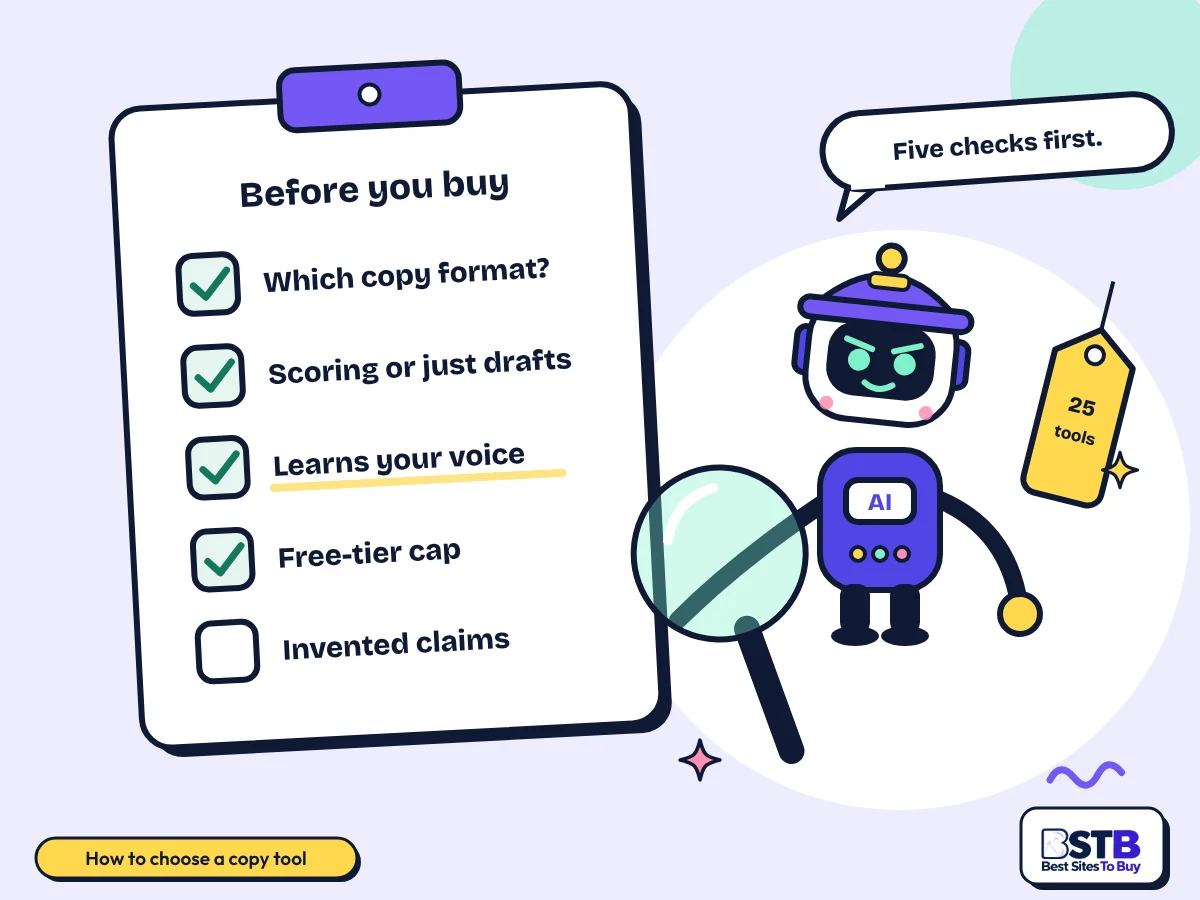
How to choose an AI copywriting tool: a checklist reading which copy format, scoring or just drafts, learns your voice, free-tier cap and invented claims
Naming the format you write most removes most of the list.
Pricing

Free vs Paid AI Copywriting Tools

Free AI copywriting tools are a minority here: 9 of the 25 have a free tier and 16 are paid or quote only, with entry plans from about $5 a month and enterprise brand platforms priced only on request.

Pricing modelTools in the top 30What you getTools
Free0 of 25Everything free, no paid tier
Freemium9 of 25Free plan with limits, paid upgradeBuffer, Voila, Easy Peasy AI, Rytr, Writecream, PostWizard AI, EtsyGenerator, CreativAI, Magic Type AI
Paid16 of 25Paid only, sometimes with a trialAnyword, Copy.ai, Frase, Hypotenuse, Moosend, Pencil, Typeface, GravityWrite, Jasper, Scalenut, Adcreative.ai, Obsess AI, Brandblast.ai, Eskritor, Listing Pro AI, SEOWriteX

Prices come from each tool's BSTB page. Two cautions specific to this category. Eleven of the tools checked have at least one price that could not be confirmed because the pricing page would not load or needs a login, and sixteen carry figures that disagree between the tool page and third-party directories. Two tools are priced in euros rather than dollars. Everything uncertain says reported on the card. Confirm on the vendor's own site before you buy.

Use with care

Limits, Claims and Fact-Checking

AI copy invents specifics, converges on the same rhythms, cannot tell you whether anything converted, and leaves you responsible for every claim it made on your behalf.

  • Invented claims: percentages, guarantees, awards and customer numbers appear unprompted and read as confidently as true ones.
  • Sameness: the same tools produce the same structures, so a market where everyone uses them converges fast.
  • No proof of performance: scoring predicts; only a test measures. Treat a predicted score as a shortlist, not a result.
  • Regulated claims: health, finance and comparative advertising have rules that apply to AI copy exactly as written.
  • Voice drift: unedited output stops sounding like your brand within a few pieces, and customers notice before you do.
  • You carry the liability: an advertising standards complaint names your business, not the tool that drafted the line.
Our method

How BSTB Rates AI Copywriting Tools

BSTB scores every one of these copywriting tools on the same nine criteria, and the overall score on each card is the plain average of the nine.

  • Accuracy and Reliability
  • Ease of Use
  • Functionality and Features
  • Performance and Speed
  • Customization and Flexibility
  • Data Privacy and Security
  • Support and Resources
  • Cost-Efficiency
  • Integration Capabilities

Scores are based on each tool's official pages, documentation, pricing and public user feedback. Read the full method on how BSTB tests and scores tools.

Related AI Tool Categories

Copywriting tools overlap with these categories. Browse them when you need a narrower tool, or go back to the full AI tools directory.

FAQs

AI Copywriting Tools: Frequently Asked Questions

Quick answers on writing ad copy that converts, generating product descriptions in bulk, landing page copy, adapting copy per audience, headlines, keeping to brand voice, fact-checking and writing in other languages.

How Can AI Help Write High-Converting Ad Copy?

By producing enough variants to test properly, and in a few cases by scoring them before you spend. Volume plus testing is the mechanism, not better sentences.

Anyword at 4.1/5 scores copy against predicted performance and Pencil at 4.0/5 scores the creative with it. That prediction is imperfect, but it beats choosing the line you personally like, which is how most ad copy gets picked.

  • Anyword: 4.1/5; predictive scoring on every variant before publishing.
  • Pencil: 4.0/5; generates, scores and launches copy with the creative.
  • Adcreative.ai: 3.8/5; scored ad text alongside the banner.
  • Still test: a predicted score narrows the shortlist. Only a live test decides.

High-converting is decided by your audience, not the tool. Generate widely, cut the invented claims, then test two.

Can AI Generate Product Descriptions in Bulk?

Yes, and it is the clearest return in the category. A handful of tools here work across a whole catalogue rather than one product at a time, which is the job that does not scale with people.

Hypotenuse at 4.1/5 writes and enriches descriptions across an entire catalogue. Obsess AI at 3.8/5 does it inside Shopify, and EtsyGenerator at 3.6/5 handles Etsy listings including tags.

  • Hypotenuse: 4.1/5; built for catalogue-scale description writing.
  • Obsess AI: 3.8/5; a Shopify app, so the copy lands in the store.
  • EtsyGenerator: 3.6/5; titles, descriptions and SEO tag sets.
  • Watch the specs: AI will invent dimensions and materials. Feed it the real data.

Measure time per description before and after. It is the easiest return in this category to prove.

How Do I Create Landing Page Copy With AI?

With an all-round tool rather than a specialist, because no tool in this category is built specifically for landing pages. That is a genuine gap, and it is worth knowing before you shop for one.

AI tools to generate landing page copy barely exist as a category: of the 41 tools listed here, none is primarily a landing-page copy tool. The practical approach is to use an all-round writer such as Writecream or CreativAI section by section, since a landing page is really five short pieces of copy with different jobs.

  • Write it in sections: hero, proof, benefits, objections, call to action. Not one prompt.
  • Lead with the objection: the best-performing sections usually answer a doubt, not list a feature.
  • Writecream: 3.9/5; broad enough to cover every section, with a free tier.
  • Brand platforms help: Jasper and Typeface keep a long page sounding like one voice.

No dedicated landing-page tool exists in this category today. Anyone claiming one is selling an all-round writer.

Can AI Adapt Copy for Different Audiences?

Yes, and it is one of the better uses. Rewriting one message for three segments takes minutes, where writing three originals takes an afternoon.

The quality depends entirely on how well you describe the segments. Adapting for 'small business owners' produces something generic; adapting for 'a two-person plumbing firm that has never advertised' produces something usable.

  • Describe the segment properly: what they believe now, not just a demographic.
  • Change the objection, not the adjectives: different audiences doubt different things.
  • Anyword: 4.1/5; scores per audience, so you can see which framing fits which.
  • Jasper: 3.9/5; audience profiles held alongside brand voice.

Swapping adjectives is not adapting. If the objection you answer does not change, neither has the copy.

Can AI Generate Headlines for Ads and Campaigns?

Yes, and headlines are the format where the volume argument is strongest. Thirty options cost nothing to generate and the good ones are rarely in the first five.

No tool in this category is a dedicated headline or slogan generator, which the competing pages also miss. In practice the ad tools do it best, because they generate headlines in sets and some of them score each one.

  • Ask for thirty: not five. Then cut to three and test two of those.
  • Anyword and Pencil: both generate headline sets with a predicted score attached.
  • Rytr: 3.9/5; cheapest option if you only need volume, with no scoring.
  • Slogans are harder: a brand line is a positioning decision, not a copy task.

Headlines are where AI earns its keep. Slogans are where it usually produces something forgettable.

How Can I Keep AI Copy Aligned With My Brand Voice?

Train the tool on your own published copy rather than describing your voice in a prompt. The tools that hold a persistent brand profile do this far better than a tone dropdown.

Typeface at 4.0/5 and Jasper at 3.9/5 are built around exactly this, which is the main reason either is worth enterprise pricing. Brandblast.ai at 3.7/5 learns the brand from your website automatically.

  • Feed it real examples: ten pieces of your best published copy beats any tone setting.
  • Write the voice down once: a short document you paste into every tool that has no profile.
  • Typeface and Jasper: persistent brand voice enforced across a whole team.
  • Audit monthly: voice drifts quietly. Read a sample against something you wrote a year ago.

A tone dropdown is not brand voice. If the tool cannot learn from your existing copy, expect to rewrite.

Should AI-Generated Marketing Copy Be Fact-Checked?

Always, and specifically for invented claims rather than typos. AI produces percentages, guarantees, awards and customer numbers that sound entirely plausible and are simply made up.

Only one of the five competing pages has a real section on this. The exposure is not theoretical: advertising standards rules apply to AI-written copy exactly as they apply to anything else, and a complaint names your business rather than the tool.

  • Check every number: percentages and customer counts are the most common inventions.
  • Check every superlative: best, leading and number one are claims you must be able to support.
  • Regulated sectors: health, finance and comparative claims carry specific rules.
  • One human approval: before anything public. It is the whole control, and it is cheap.

The faster the production, the more the approval step matters. Speed is exactly what makes this risky.

Can AI Copywriting Tools Write in Multiple Languages?

Most claim multilingual output and few are tested on it. Quality drops sharply outside the major European languages, and marketing copy suffers more than general text because idiom and register carry the persuasion.

No competitor page covers this beyond a passing clause. A tool that writes well in English can produce stiff, literal copy in another language that no native speaker would call persuasive, and brand voice training is almost always English-first.

  • Test in your language: with your own product and a native speaker reading it.
  • Literal translation reads badly: especially for headlines, where idiom does the work.
  • Voice transfer is weak: tone trained on English examples rarely carries over.
  • Check the claim: a language list is not the same as usable marketing copy in it.

Grammatically correct and persuasive are different standards. Only a native speaker can judge the second.

How Do I Prove the AI Copy Actually Performed Better?

Capture a baseline, change one thing, and compare like periods. Predictive scoring is a shortlist tool, not evidence, and no competing page explains the difference.

Every page in this SERP sells the scoring features of tools. None explains how to tell whether the tool earned its subscription. The method is unglamorous and it works, and it is the only thing that justifies the spend to anyone who asks.

  • Baseline first: current click-through, conversion rate and cost per acquisition.
  • One change at a time: swapping three tools at once tells you nothing about any of them.
  • Test the variants: AI's value is volume to test, so testing is how you collect it.
  • Count the hours too: time saved is real value and is usually the honest win.

A predicted score is a hypothesis. A split test is a result. Do not report the first as the second.

Can AI-Written Ads Get Rejected by the Ad Platforms?

Yes, and it is a live risk nobody in this SERP mentions. Ad platforms reject copy for unsupported claims, prohibited wording and category-specific rules, and AI generates all three without warning you.

The pattern is predictable. AI writes superlatives and guarantees because they read as persuasive, and those are exactly what trigger review in regulated categories. Health, finance, employment and housing have the strictest rules.

  • Unsupported superlatives: the single most common rejection trigger in generated copy.
  • Guarantees and outcomes: promised results are restricted on every major platform.
  • Restricted categories: health, finance, employment and housing have extra rules.
  • Review before upload: one pass against the platform's policy saves a disapproval cycle.

A rejected ad costs you the campaign window, not just the resubmission. Read generated copy for claims first.

Will Google Penalise AI-Written Copy?

Not for being AI-written. Google's guidance targets scaled content abuse, meaning mass-produced pages made primarily to rank rather than to help, however they were produced.

Two of the five competing pages raise this and both answer the soft version. The distinction that matters is between using AI to write a page worth reading and using it to produce volume. Product and landing copy edited into something specific is not what the policy is aimed at.

  • Fine: AI-assisted copy, edited, with real information about a real product.
  • Not fine: hundreds of near-identical pages differing only by a keyword.
  • Edit the output: unedited text is near-duplicate across everyone using the same tool.
  • Answer engines too: the SEO tools here increasingly track citations as well as rankings.

The question is whether the page helps someone, not which tool typed it.

What Do Free AI Copywriting Plans Actually Limit?

Words, credits or seats, almost never time. 9 of the 25 tools here have a free tier, and the cap is usually discovered mid-campaign rather than on the pricing page.

No competing page compares free-tier limits, even though three of them quote limits in scattered prose. The practical question is not whether a free plan exists but whether its cap survives one real campaign.

  • Word and credit caps: the most common shape, and the easiest to exhaust unexpectedly.
  • Seat limits: free plans stop being free at the team size you actually have.
  • Writecream: 3.9/5; Free Forever tier, the most usable in this set.
  • Buffer and Rytr: both have genuine free tiers worth testing with.

Run one real campaign on the free tier before paying. That is what tells you where the cap bites.

Do I Need a Copywriting Tool, or Is a General AI Writing Assistant Enough?

For occasional copy, a general assistant is enough and cheaper. For marketing volume, a dedicated tool wins on two things: it knows the format, and a few of them score output against performance.

This matters more here than in most categories, because 16 of the 41 tools tagged Copywriting on BSTB are really general writing assistants, humanizers or rewriters. Those are not worse tools; they are a different job, and a sister category covers them properly.

  • Occasional copy: a general assistant is fine and costs less.
  • Marketing volume: format knowledge and variant scoring start to matter.
  • Brand across a team: only the dedicated platforms solve this.
  • Rewriting existing text: that is paraphrasing; see the paraphrasing category.

If nothing in the tool knows the difference between an ad and an email, it is a writing assistant.

How Does BSTB Score AI Copywriting Tools?

BSTB scores every copywriting tool on nine criteria: accuracy and reliability, ease of use, functionality, performance, customisation, data privacy, support, cost-efficiency and integrations.

The score on each card is the plain average of those nine. All 41 tools listed in this category were checked individually and 25 are on this page. Scores in this category are tightly bunched between 2.9 and 4.1, so the filter group and the summary matter as much as the number.

  • Nine criteria: each scored separately, then averaged.
  • 41 listed, 41 checked: nothing on this page was estimated.
  • Ranking here: ordered by overall score, ties alphabetically.
  • Full method: see how BSTB tests and scores tools.

Card ratings on the category listing all show 0.0 and are never used for ranking.

How Often Is This List of AI Copywriting Tools Updated?

BSTB rechecks this list whenever a tool changes its pricing, plans or availability, and reviews the whole category on a rolling basis as new tools are listed.

This category consolidates fast. Several tools here are mid-acquisition or have pivoted away from copywriting entirely, and pricing is unusually unreliable: eleven tools have at least one price that could not be confirmed. Each tool's own BSTB page carries the last checked figures.

  • Rolling review: rechecked as tools launch, change price or disappear.
  • Status flags: shown on the card when a tool is renamed, in beta or changing hands.
  • Per-tool pages: the detail lives on each tool's own review page.
  • Spotted a change: tell us through the contact page.

Where a price is marked reported, confirm it with the vendor before budgeting against it.

Psst! Built an AI copywriting tool?

Get Your AI Copywriting Tool Listed on BSTB

Send us your tool's name, website and pricing. The BSTB team reviews every submission before it joins the AI tools directory.

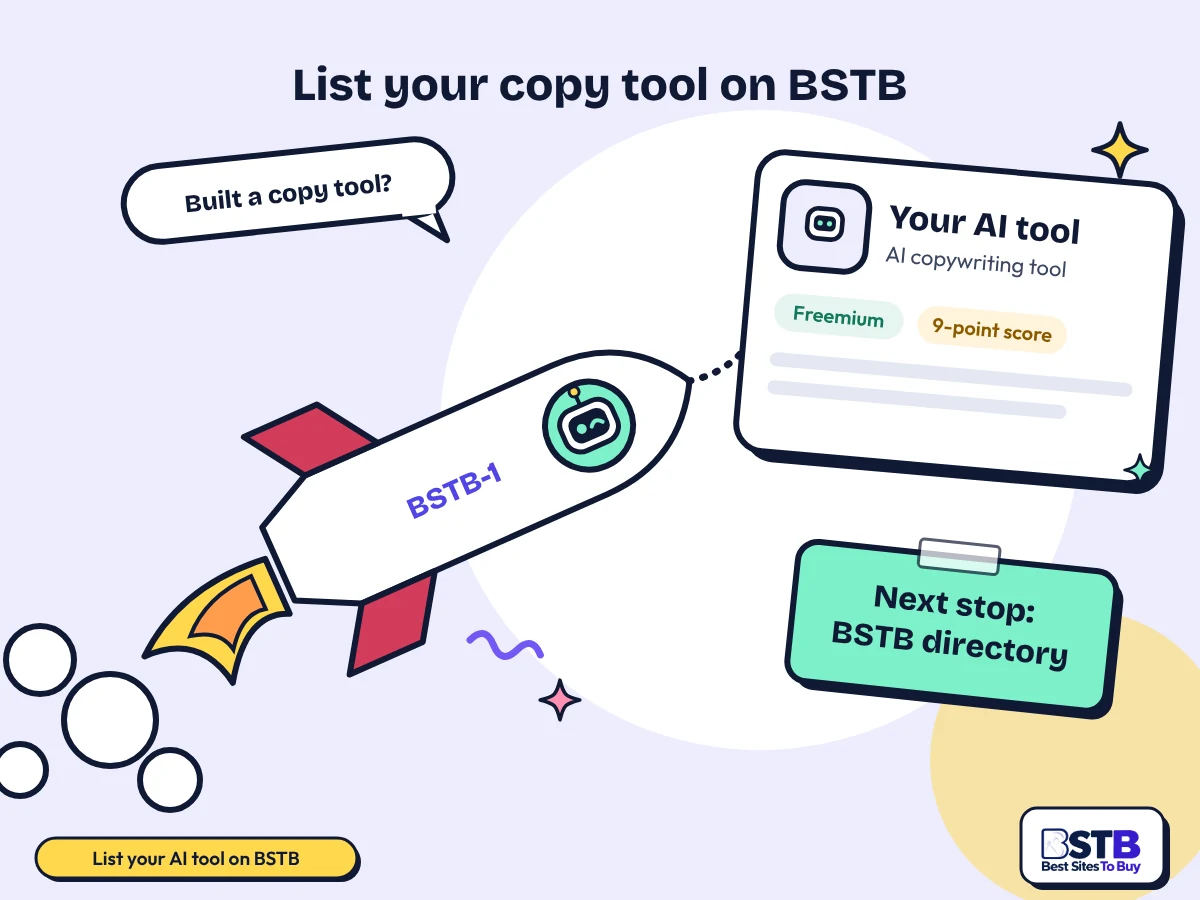
List your AI copywriting tool on BSTB: a rocket labelled BSTB-1 carrying Scout towards a directory card with a freemium badge and a nine point score
On this page