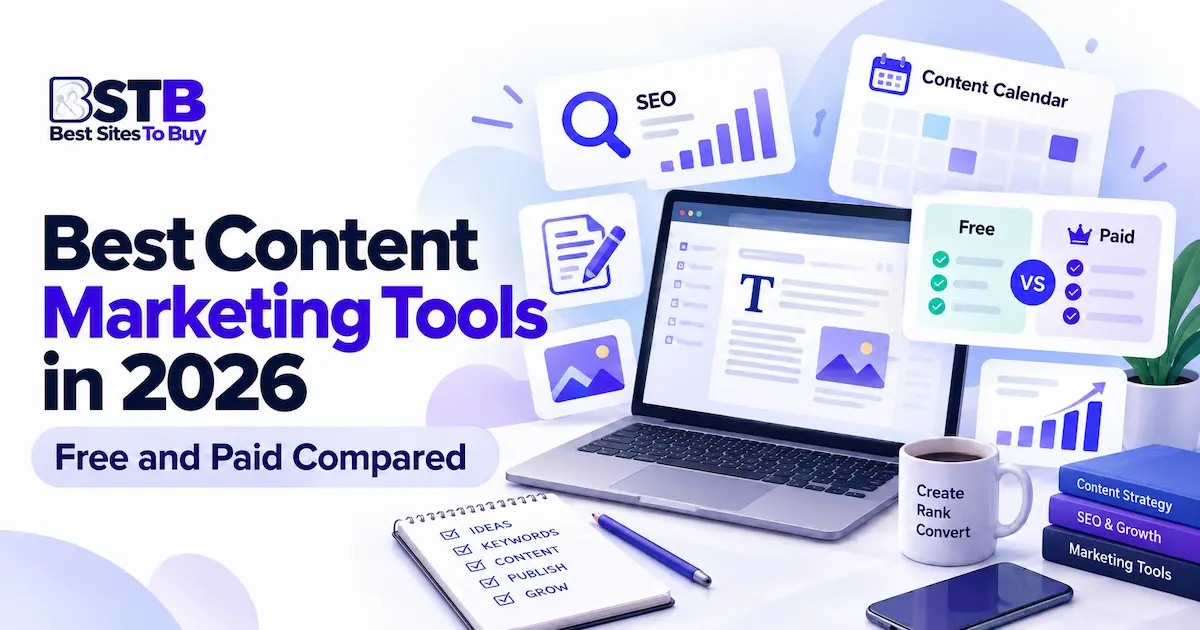
Quick answer: The best content marketing tools in 2026 include ChatGPT for ideas and drafts, Semrush and Google Search Console for SEO, Canva for design, Descript and Opus Clip for video, Buffer and Later for social scheduling, Mailchimp for email, Notion or Trello for planning, and Google Analytics or Metricool for measuring results.
Content marketing tools help you plan, create, optimize, publish and measure content without a large team. The right stack saves hours every week and turns scattered ideas into a consistent content engine that drives traffic, leads and sales.
When I build a content stack for a brand, I pick one tool for each stage of the workflow before adding anything else: planning, creation, SEO, distribution and analytics. Most teams overspend on overlapping software. This guide compares 20 free and paid content marketing tools by category, so you can build a lean stack and compare details on our tools and AI tools pages.
What Are Content Marketing Tools?
Content marketing tools are software platforms that help you plan, research, create, optimize, publish, distribute and measure content such as blog posts, videos, social posts and emails. They range from free apps for individuals to all-in-one content marketing platforms built for agencies and enterprise teams.
Most businesses use several specialized tools rather than one platform. A typical stack might include an AI writing assistant, an SEO research tool, a design app, a social scheduler, an email platform and an analytics dashboard. Together, these tools cover the full workflow from idea to results.
- Planning: calendars, project boards and briefs.
- Creation: writing, design and video tools.
- Optimization: SEO research and on-page guidance.
- Distribution and analytics: scheduling, email and reporting.
How Do You Choose the Best Content Marketing Tools?
Choose the best content marketing tools by matching them to your goals, team size, budget and content types. Start with the stage of your workflow that wastes the most time, test free plans or trials first, and only pay for tools that clearly save hours or improve results.
Check integrations before you commit, because tools that connect to your CMS, social accounts and analytics save manual work. Consider ease of use for your whole team, data privacy and how pricing scales as you add users or content. A smaller, well-connected stack usually beats many overlapping subscriptions.
- Goals first: traffic, leads, brand awareness or sales.
- Budget: start with free plans and trials.
- Integrations: CMS, social, email and analytics connections.
- Ease of use: tools your team will actually adopt.
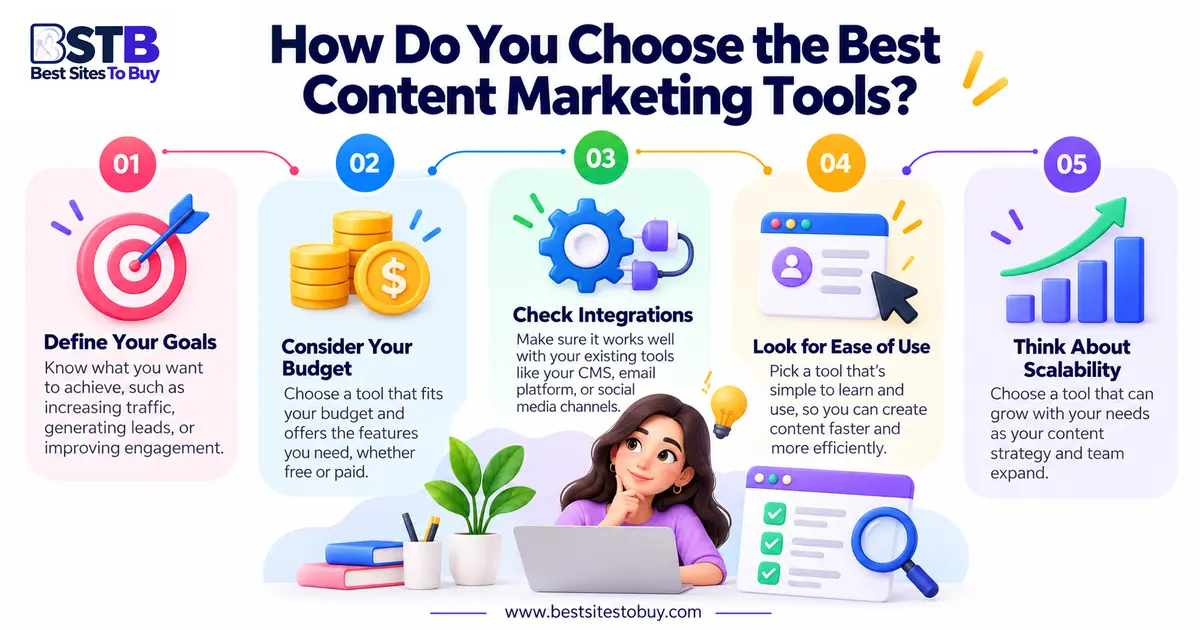
Learn how to choose content marketing tools that match your business goals, budget, and content creation needs.
What Are the Best Content Marketing Tools in 2026? Comparison Table
The best content marketing tools in 2026 cover seven categories: AI writing, SEO, design, video, social scheduling, email and analytics, plus planning tools to keep everything organized. The comparison table below shows each tool’s category, whether it offers a free plan or free trial, and what it does best.
Pricing changes frequently, so check each provider’s website or our review pages for current plans before buying. Many tools offer free versions with limits on users, projects or credits, which are enough for solo creators and small businesses testing a new content marketing workflow.
| Content marketing tool | Category | Free option | Best for |
|---|---|---|---|
| ChatGPT | AI writing | Free plan | Ideas, outlines, drafts and repurposing |
| Grammarly | Writing and editing | Free plan | Grammar, clarity and tone |
| Semrush | SEO research | Free account with limits | Keywords, competitors and content audits |
| Ahrefs Webmaster Tools | SEO research | Free for verified sites | Site audits and backlink checks |
| Google Search Console | SEO performance | Free | Search queries, clicks and indexing |
| Surfer SEO | On-page SEO | Paid | Content optimization scores |
| Canva | Design | Free plan | Social graphics, carousels and infographics |
| Descript | Video and audio | Free plan | Text-based video and podcast editing |
| Opus Clip | Video repurposing | Free plan | Turning long videos into short clips |
| Submagic | Video captions | Free trial | Captions and short-form edits |
| Buffer | Social scheduling | Free plan | Simple scheduling for small teams |
| Later | Social scheduling | Free trial | Visual planning for Instagram and TikTok |
| Sprout Social | Social management | Free trial | Publishing, inbox and reporting for teams |
| Metricool | Social analytics | Free plan | Scheduling and analytics in one dashboard |
| Mailchimp | Email marketing | Free plan | Newsletters and automations |
| HubSpot | All-in-one marketing | Free tools | CRM, email, forms and content |
| WordPress | Publishing (CMS) | Free open-source software | Blogs and content websites |
| Google Analytics | Analytics | Free | Traffic, engagement and conversions |
| Notion | Planning | Free plan | Content calendars, briefs and docs |
| Trello | Planning | Free plan | Kanban content workflows |
- Free options: most tools offer a free plan or trial.
- Check pricing: plans and limits change often.
- Mix and match: pick one tool per category.
What Are the Best AI Writing Content Marketing Tools?
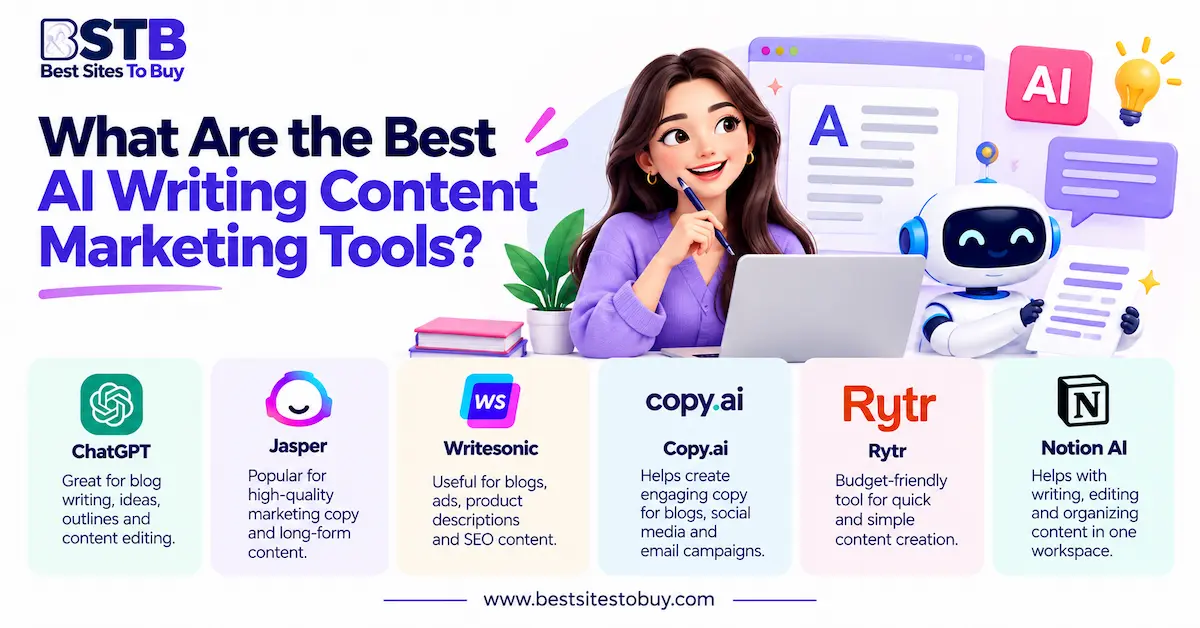
Discover the best AI writing tools to create blog posts, marketing copy, social media content, and engaging website content.
The best AI writing content marketing tools in 2026 are ChatGPT for ideas, outlines and drafts, and Grammarly for editing grammar, clarity and tone. AI writing tools speed up research and first drafts, so your team spends more time on expertise, original insight and editing.
Use AI as an assistant, not a replacement. Give it clear prompts with your audience, goal and tone, then fact-check and rewrite in your brand voice. Search engines and readers reward helpful, accurate content, so human editing and real experience remain essential parts of any AI content marketing workflow.
- Ideation: topic lists, angles and headlines.
- Drafting: outlines and first drafts in minutes.
- Editing: grammar, clarity and tone checks.
- Repurposing: turn blogs into emails and social posts.
ChatGPT: Best AI Content Marketing Tool for Ideas and Drafts
ChatGPT helps content marketers brainstorm topics, write outlines, draft posts and repurpose content into emails and social captions. It has a free plan, with paid plans for advanced models and features.
- Free option: yes, free plan available.
- Best for: ideas, outlines, drafts and repurposing.
- Tip: always fact-check and edit outputs.
Grammarly: Best Content Marketing Tool for Editing and Tone
Grammarly checks grammar, spelling, clarity and tone across browsers, documents and email. It helps content teams publish cleaner copy faster and keep writing consistent with brand style guidelines.
- Free option: yes, free plan available.
- Best for: proofreading and tone consistency.
- Works in: browsers, docs and email apps.
What Are the Best SEO Content Marketing Tools?
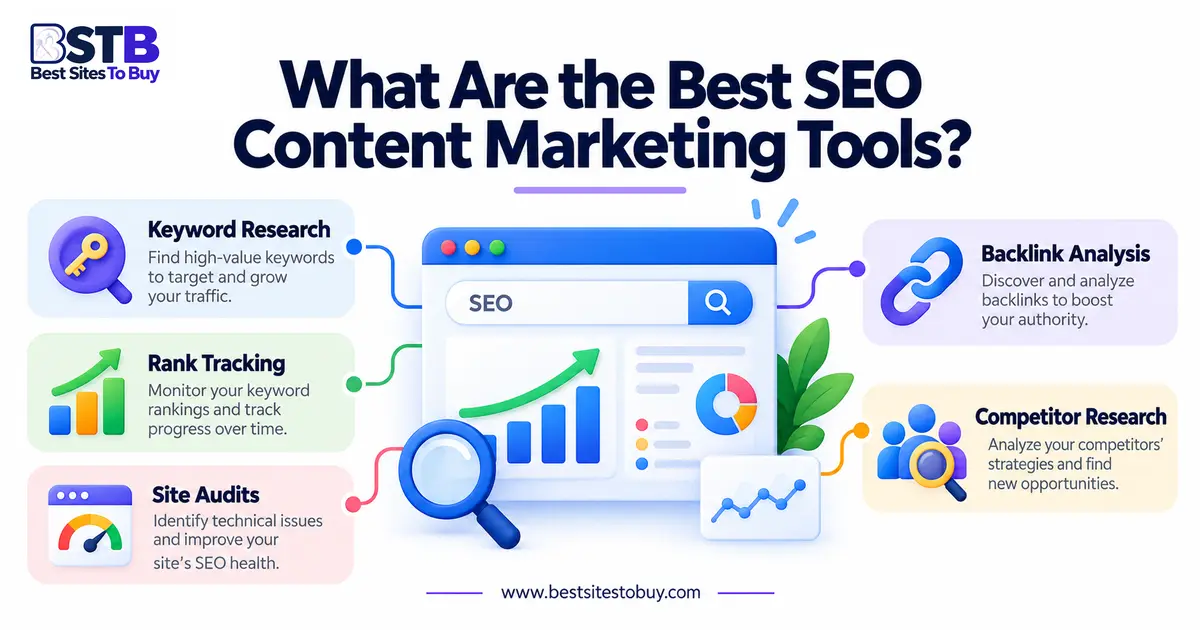
Explore the best SEO content marketing tools for keyword research, content optimization, and improving search visibility.
The best SEO content marketing tools are Semrush for keyword and competitor research, Ahrefs Webmaster Tools for site audits and backlinks, Google Search Console for real search performance data, and Surfer SEO for on-page optimization. These tools help your content rank and reach people actively searching for answers.
Start with free tools like Google Search Console and Ahrefs Webmaster Tools, which give reliable data about your own site. Add a paid research tool when you need competitor insights, keyword difficulty data and content gap analysis. SEO and content marketing work best together, because rankings bring steady, compounding traffic.
- Keyword research: find topics people search for.
- Competitor analysis: see what ranks and why.
- Site health: fix technical issues that block rankings.
- On-page optimization: improve existing content.
Semrush: Best Content Marketing Tool for Keyword and Competitor Research
Semrush is an all-in-one SEO and content marketing platform for keyword research, competitor analysis, content audits and topic ideas. A free account offers limited daily searches before upgrading.
- Free option: free account with limits.
- Best for: keywords, competitors and content gaps.
- Extra: writing assistant and position tracking.
Ahrefs Webmaster Tools: Best Free SEO Content Marketing Tool for Audits
Ahrefs Webmaster Tools lets you audit your own website and see backlinks and organic keywords for free once you verify ownership. It is a strong starting point for small teams on tight budgets.
- Free option: free for verified websites.
- Best for: site audits and backlink checks.
- Upgrade: full Ahrefs for competitor research.
Google Search Console: Best Free Content Marketing Tool for Search Data
Google Search Console shows which search queries bring people to your content, your clicks, impressions and positions, plus indexing issues. It is free and essential for every content marketing team.
- Free option: completely free.
- Best for: real search performance data.
- Use it to: find pages to update and expand.
Surfer SEO: Best Content Marketing Tool for On-Page Optimization
Surfer SEO analyzes top-ranking pages and gives a content score with suggested terms, headings and length, helping writers optimize new and existing articles for search intent.
- Free option: paid plans only.
- Best for: on-page content optimization.
- Tip: prioritize readability over score chasing.
What Are the Best Design and Video Content Marketing Tools?
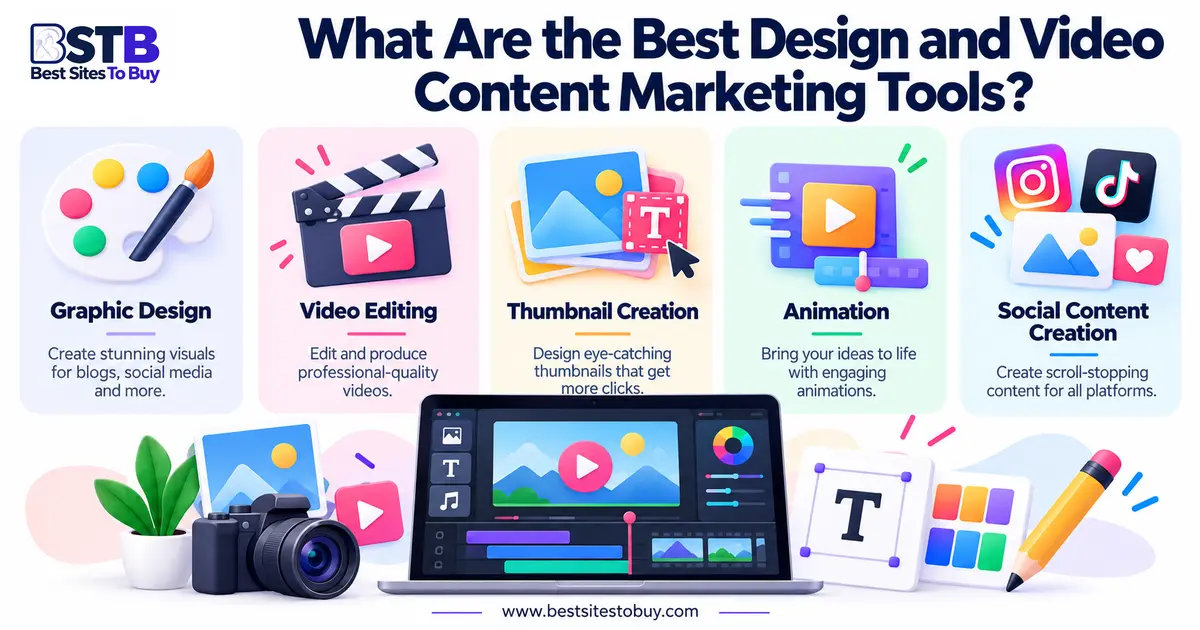
Compare design and video content marketing tools for creating eye-catching graphics, engaging videos, and branded marketing content.
The best design and video content marketing tools are Canva for graphics and carousels, Descript for text-based video and podcast editing, Opus Clip for turning long videos into short clips, and Submagic for automatic captions. Visual content earns more engagement on social media, so these tools are essential.
AI-powered video tools have made short-form content far easier to produce. You can record one webinar or podcast, edit it in Descript, cut highlights with Opus Clip and add captions with Submagic, turning a single recording into a week of Reels, Shorts and TikTok videos.
- Graphics: social posts, infographics and carousels.
- Video editing: cut footage by editing text.
- Repurposing: long videos into short clips.
- Captions: subtitles for silent viewers.
Canva: Best Content Marketing Tool for Graphics and Templates
Canva makes it easy to design social graphics, carousels, infographics, presentations and thumbnails using templates and brand kits, with a free plan and paid plans for teams.
- Free option: yes, free plan available.
- Best for: social graphics and infographics.
- Teams: brand kits keep visuals consistent.
Descript: Best Content Marketing Tool for Video and Podcast Editing
Descript lets you edit video and audio by editing a transcript, remove filler words automatically and create clips, making video and podcast production much faster for content teams.
- Free option: yes, free plan available.
- Best for: text-based video and podcast editing.
- Extras: transcription, captions and clips.
Opus Clip: Best Content Marketing Tool for Repurposing Long Videos
Opus Clip uses AI to find the most engaging moments in long videos and turn them into short vertical clips for Reels, Shorts and TikTok, complete with captions.
- Free option: yes, free plan with credits.
- Best for: turning webinars and podcasts into clips.
- Output: vertical videos with captions.
Submagic: Best Content Marketing Tool for Video Captions
Submagic automatically adds styled captions, emojis and effects to short-form videos, helping your content perform better with the many viewers who watch short videos without sound on Reels, TikTok and Shorts.
- Free option: free trial available.
- Best for: captions and short-form polish.
- Platforms: Reels, TikTok and Shorts.
What Are the Best Social Media Content Marketing Tools?
The best social media content marketing tools are Buffer for simple scheduling, Later for visual Instagram and TikTok planning, Sprout Social for team publishing and reporting, and Metricool for scheduling plus analytics in one dashboard. These tools keep your posting consistent and show which content performs best.
Scheduling tools save time by letting you batch-create content and publish automatically across platforms. Analytics features reveal the best posting times, top formats and audience growth, helping you refine your content strategy. Choose a tool based on how many accounts you manage and how much reporting you need.
- Scheduling: plan and auto-publish posts.
- Visual planning: preview your Instagram grid.
- Team workflows: approvals and shared inboxes.
- Analytics: track engagement and growth.
Buffer: Best Content Marketing Tool for Simple Social Scheduling
Buffer offers easy social media scheduling across major platforms, with a free plan for a few channels and affordable paid plans for growing teams that need more features.
- Free option: yes, free plan available.
- Best for: solo creators and small teams.
- Strength: clean, simple interface.
Later: Best Content Marketing Tool for Visual Social Planning
Later is built for visual planning, letting you schedule Instagram, TikTok and other posts with a drag-and-drop calendar, grid preview and link-in-bio tools that help creators and brands keep their feed consistent.
- Free option: free trial available.
- Best for: Instagram and TikTok planning.
- Extras: link in bio and best time to post.
Sprout Social: Best Content Marketing Tool for Social Teams
Sprout Social combines publishing, a unified social inbox, listening and detailed reporting, making it a strong choice for brands and agencies managing many accounts and team members.
- Free option: free trial available.
- Best for: teams, agencies and enterprises.
- Strength: reporting and social listening.
Metricool: Best Content Marketing Tool for Social Analytics
Metricool brings scheduling, analytics and competitor tracking together in one dashboard, with a free plan that suits small brands, freelancers and creators who want simple reporting without a big budget.
- Free option: yes, free plan available.
- Best for: analytics plus scheduling.
- Extras: competitor and ads reporting.
What Are the Best Email and All-in-One Content Marketing Tools?
The best email and all-in-one content marketing tools are Mailchimp for newsletters and automations, HubSpot for free CRM, email, forms and content tools, and WordPress for publishing and managing a content-driven website. These tools help you own your audience instead of relying only on social platforms.
Email remains one of the most direct ways to share content with people who already know your brand. Pair your blog or website with a newsletter, use forms to grow your list, and send regular updates that link back to your best articles, videos and offers.
- Email: newsletters and automated sequences.
- CRM: track leads and customer relationships.
- Publishing: blogs and content websites.
- Lead capture: forms and landing pages.
Mailchimp: Best Content Marketing Tool for Email Newsletters
Mailchimp helps you design newsletters, build email lists and set up automations, with a free plan for small lists and paid plans with advanced segmentation and reporting.
- Free option: yes, free plan with limits.
- Best for: newsletters and simple automations.
- Extras: templates, forms and landing pages.
HubSpot: Best All-in-One Content Marketing Platform
HubSpot offers free CRM, email, forms and content tools, with paid Marketing Hub plans adding automation, SEO recommendations and reporting for growing businesses that want everything in one place.
- Free option: yes, free tools available.
- Best for: businesses needing CRM plus content.
- Strength: connects content to leads and sales.
WordPress: Best Content Marketing Tool for Publishing
WordPress is free, open-source software that powers a large share of websites. It lets you publish blogs and content hubs, with thousands of themes and plugins for SEO, forms and analytics.
- Free option: free software, hosting costs extra.
- Best for: blogs and content websites.
- Plugins: SEO, forms and performance tools.
What Are the Best Analytics and Planning Content Marketing Tools?
The best analytics and planning content marketing tools are Google Analytics for website traffic and conversions, Notion for content calendars and briefs, and Trello for simple kanban workflows. Planning tools keep content organized, while analytics tools prove what is working and guide what to create next.
A simple content calendar prevents last-minute scrambling and keeps your team aligned on topics, deadlines and owners. Analytics closes the loop by showing which articles, videos and posts bring traffic, leads and sales, so you can double down on the content that delivers measurable results.
- Calendars: plan topics, owners and deadlines.
- Briefs: share goals, keywords and outlines.
- Website analytics: traffic, engagement and conversions.
- Reporting: decide what to create next.
Google Analytics: Best Free Content Marketing Tool for Measuring Results
Google Analytics tracks website traffic, engagement and conversions for free, showing which content attracts visitors, keeps them engaged and turns them into leads or customers, so you can focus on what works.
- Free option: completely free.
- Best for: traffic and conversion tracking.
- Tip: set up conversion events for key actions.
Notion: Best Content Marketing Tool for Calendars and Briefs
Notion combines docs, databases and calendars in one workspace, making it easy to manage content calendars, briefs, style guides and idea backlogs, with a free plan for individuals.
- Free option: yes, free plan available.
- Best for: calendars, briefs and wikis.
- Templates: ready-made content calendars.
Trello: Best Content Marketing Tool for Simple Workflows
Trello uses boards, lists and cards to manage content workflows visually, moving each piece from idea to draft, review and published, with a free plan for small teams.
- Free option: yes, free plan available.
- Best for: simple kanban content workflows.
- Automation: rules for repetitive tasks.
What Is the Best Free Content Marketing Tool Stack?
The best free content marketing tool stack combines ChatGPT for ideas, Grammarly for editing, Google Search Console and Ahrefs Webmaster Tools for SEO, Canva for design, Buffer or Metricool for social scheduling, Mailchimp for email, Notion or Trello for planning and Google Analytics for measurement.
This free stack covers every stage of the workflow and is enough for solo creators and small businesses starting out. Upgrade only when a free plan’s limits slow you down, such as needing more social accounts, team members, keyword searches or advanced reporting.
| Workflow stage | Free content marketing tool |
|---|---|
| Ideas and drafts | ChatGPT |
| Editing | Grammarly |
| SEO | Google Search Console, Ahrefs Webmaster Tools |
| Design | Canva |
| Social scheduling | Buffer or Metricool |
| Mailchimp | |
| Planning | Notion or Trello |
| Analytics | Google Analytics |
- Start free: cover every stage at no cost.
- Upgrade wisely: pay only when limits slow you down.
- Stay lean: avoid overlapping subscriptions.
What Content Marketing Tool Mistakes Should You Avoid?
The most common content marketing tool mistakes are buying too many overlapping tools, choosing software your team will not use, ignoring integrations and relying on AI without human editing. These mistakes waste budget and slow down your content workflow instead of improving it.
Review your stack every few months. Cancel tools nobody uses, combine overlapping features and check whether each paid subscription still saves time or improves results. Training your team on the tools you keep often delivers more value than adding new software.
- Overlap: two tools doing the same job.
- Low adoption: tools the team avoids.
- No integrations: manual copying between apps.
- AI without editing: generic, inaccurate content.
Conclusion: Build a Lean Content Marketing Tool Stack in 2026
The best content marketing tools are the ones that cover each stage of your workflow without overlap: planning, creation, SEO, distribution and analytics. Start with free plans, measure what saves time and upgrade only the tools that clearly improve your results.
If you want to compare features, pricing and reviews before you buy, BestSitesToBuy brings trusted reviews of AI tools, social media schedulers and marketing software together in one place, so you can build the right content marketing stack with confidence.
Frequently Asked Questions
Content marketing tools are software platforms that help you plan, research, create, optimize, publish, distribute and measure content such as blog posts, videos, social posts and emails.
Planning: calendars and briefs in tools like Notion or Trello.
Creation: AI writing, design and video editing tools.
Analytics: traffic, engagement and conversion tracking.
Most businesses use several specialized tools rather than one platform. Choosing one tool for each stage of your workflow keeps your stack simple, affordable and easy for your team to use every day, without paying for overlapping features or unused subscriptions.
Google Search Console and Google Analytics are among the best free content marketing tools, because they show how people find your content and what they do after arriving on your site.
Search Console: queries, clicks, impressions and positions.
Analytics: traffic, engagement and conversions.
Other free picks: ChatGPT, Canva, Grammarly and Buffer.
A well-chosen free stack can easily cover every stage of content marketing. Combine free planning, writing, design, scheduling and analytics tools, then upgrade only when a plan’s limits start slowing down your workflow, team collaboration or reporting.
ChatGPT is one of the most popular AI tools for content marketing, helping with topic ideas, outlines, first drafts, headlines and repurposing content into emails and social posts.
Ideas: brainstorm topics and angles quickly.
Drafts: create outlines and first versions.
Repurposing: turn articles into captions and newsletters.
AI works best as a fast, helpful assistant for busy teams. Always fact-check, add your own expertise and edit outputs in your brand voice, because readers and search engines consistently reward original, accurate and genuinely helpful content written by real experts.
For small businesses, an all-in-one option like HubSpot’s free tools, combined with Canva, Buffer or Metricool and Google Analytics, gives a practical content marketing platform without a large budget.
HubSpot: free CRM, email and forms.
Canva: easy social graphics and templates.
Buffer or Metricool: simple scheduling and analytics.
Start with free plans, focus on one or two main content channels and carefully track which content brings real leads. Upgrade tools only when your content volume, team size or reporting needs clearly require more advanced features and integrations.
Content marketers typically use AI writing assistants, SEO research tools, design apps, video editors, social media schedulers, email platforms, project management tools and analytics dashboards.
Writing and SEO: ChatGPT, Grammarly, Semrush and Search Console.
Design and video: Canva, Descript and Opus Clip.
Distribution: Buffer, Later, Sprout Social and Mailchimp.
The exact stack depends on goals, content types and budget. Many teams start with free versions, then invest in paid tools for SEO research, team collaboration and advanced reporting as their content programs grow and results start to justify the extra investment.
The best SEO tools for content marketing are Semrush for keyword and competitor research, Google Search Console for performance data, Ahrefs Webmaster Tools for audits and Surfer SEO for on-page optimization.
Research: find keywords, topics and content gaps.
Performance: track clicks, impressions and rankings.
Optimization: improve headings, terms and structure.
Start with the free tools first to learn how your current content actually performs, then add a paid research tool when you need competitor data and deeper keyword insights to plan new content that targets realistic, high-value topics your audience actually searches for.
Yes, free content marketing tools are good enough for solo creators and small businesses, covering planning, writing, design, scheduling, email and analytics with some limits on users, accounts or features.
Enough for: small teams and early-stage brands.
Common limits: fewer users, accounts or credits.
Upgrade when: limits slow your workflow.
A well-chosen free stack often outperforms an expensive, unused one that nobody on the team opens. Focus on consistent, helpful content first, because tools only amplify a clear strategy that already works for your audience and business goals.
The best video tools for content marketing include Descript for text-based editing, Opus Clip for turning long videos into short clips, Submagic for captions and Canva for simple video graphics.
Descript: edit video by editing the transcript.
Opus Clip: AI clips from webinars and podcasts.
Submagic: styled captions for short-form videos.
Video is one of the most engaging and shareable content formats online, and AI tools now make editing and repurposing fast enough for small teams and solo creators to publish engaging short videos consistently every single week.
Build a content marketing tool stack by choosing one tool for each workflow stage: planning, creation, SEO, design, distribution and analytics, starting with free plans and adding paid tools only when needed.
Map your workflow: list each step from idea to results.
Pick one tool per step: avoid overlap.
Check integrations: connect CMS, social and analytics.
Review your stack every few months and cancel tools your team does not use. A lean, connected stack saves money and keeps your content process fast, organized and consistent as your team grows.
Content marketing tools range from completely free options like Google Analytics and Search Console to paid plans that vary widely by features, users and usage, from low monthly fees to enterprise pricing.
Free: Search Console, Analytics and free plans of many tools.
Low cost: schedulers, design and AI writing plans.
Higher cost: advanced SEO suites and enterprise platforms.
Pricing changes often, so compare current plans before buying. Start with free trials, measure time saved and results, then invest only in the tools that deliver a clear, measurable return for your business.
